
Best Stocks for the Wheel Strategy 2026
What are the best stocks for the wheel strategy in 2026? Use this screening framework for cash-secured puts and covered calls: liquidity floors, IV percentile bands, and assignment risk so you can cycle premium without trapping capital in weak underlyings.
This guide gives you the exact framework I use to find wheel-ready stocks, the sectors that consistently work best, and specific examples you can apply to your own portfolio today.
Turn This Screening Guide Into a Wheel Watchlist
Test whether a stock is wheel-worthy before you commit capital.
Wheel Strategy Backtest
Simulate cash-secured puts → covered calls on historical data. Click Run to start (no auto-run).
Set parameters above and click Run to backtest the wheel on SPY.
Backtest the wheel on liquid names before you commit capital — adjust DTE/OTM above, then open the full tool for multi-year ranges and reinvestment comparison.
Find CSP Stocks for Your Style
Answer 3 quick questions and we'll find live CSP candidates you might be comfortable owning.
What kind of stocks would you be comfortable owning?
CSPs can end with assignment, so pick businesses you don't mind holding.
Best Stocks for the Wheel Strategy: 2026 Screening Guide
What Is the Wheel Strategy?
Before diving into stock selection, let's clarify what makes a stock "wheel-appropriate." The wheel consists of two phases:
Phase 1: Cash-Secured Puts
- Sell out-of-the-money puts on a stock you'd be happy to own
- Collect premium immediately
- If the stock stays above your strike, the put expires worthless and you keep the premium
- If the stock drops below your strike, you get assigned and buy the shares
Phase 2: Covered Calls
- Once assigned, sell covered calls against your shares
- Collect additional premium while holding the position
- If the stock stays below your call strike, you keep the shares and premium
- If the stock rises above your call strike, your shares get called away and you keep the premium plus any gains up to the strike
Phase 3: Repeat
- If your shares were called away, return to Phase 1
- If you still hold shares, continue Phase 2
The key insight: you only want to run the wheel on stocks you're genuinely comfortable owning long-term. Poor stock selection turns the wheel into a trap rather than an income engine.
The Wheel Stock Screening Framework
When evaluating a stock for the wheel, I filter for three core qualities that separate profitable candidates from capital traps.
1. Premium Richness (Implied Volatility & Bid-Ask Spread)
The money in wheel strategies comes from selling premium—both puts and calls. A stock with crushed implied volatility (IV) won't generate meaningful income, no matter how stable the underlying company is.
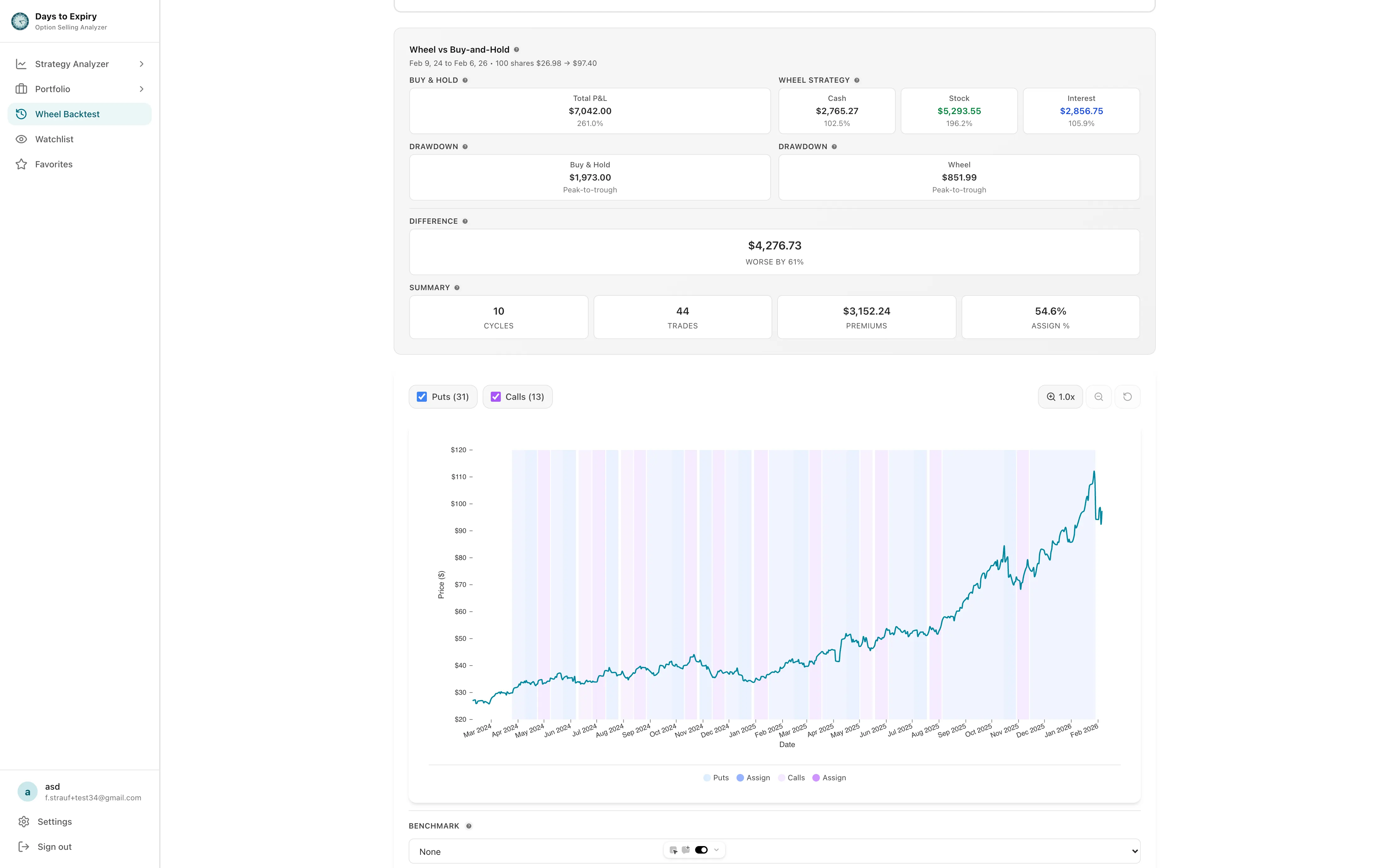 Backtesting covered calls strategy performance across market conditions
What to look for:
-
IV Percentile above 30%: This tells you the IV is richer than it's been for much of the past year. IV Percentile measures what percentage of the time IV has been lower than its current level. Higher percentiles mean more expensive options relative to historical norms.
-
At least 2-3% monthly premium available: On a $50 stock, you should be able to sell 30-45 DTE puts with a $1-$1.50 strike width, or sell 30-45 DTE calls against 100 shares for $1+ per share. Anything less and your capital efficiency suffers.
-
Bid-ask spread under 5% of strike price: If your put is worth $1.50 at the mid-price, the spread shouldn't exceed $0.07-$0.10. Wide spreads eat directly into your edge, especially when you're trading frequently.
Red flag: If you can only generate 0.5-1% monthly premium, move on. Your capital is better deployed elsewhere. You're taking assignment risk for insufficient compensation.
2. Volatility Stability (Predictable IV Patterns)
The worst-case scenario in wheel trading is a stock that spikes in IV one day and collapses the next. You want predictable, mean-reverting volatility that you can plan around.
What to look for:
-
Historical Volatility (HV) within 20-30% of IV: If a stock's implied volatility is 40% but historical volatility is 15%, expect mean reversion (IV crush). That's dangerous if you've sold premium expecting volatility to persist. The sweet spot is when IV and HV are reasonably aligned.
-
IV rank/percentile consistency: Review the IV Rank for the past 3 months. Ideally, it hovers in the 30-60 range. Stocks that spike to 90+ then crash to 10% are unpredictable and dangerous for consistent income strategies.
-
Earnings-driven vol spikes, not constant chop: If IV jumps predictably around earnings dates, you can avoid selling into those periods or size down accordingly. Avoid stocks where IV spikes randomly due to news, rumors, or speculative trading.
Red flag: Penny stocks, pre-IPO plays, or biotech names (outside earnings dates) often fail this test. Their volatility is erratic and unpredictable.
3. Liquidity & Capital Efficiency
Illiquid stocks cost you money through wide spreads and slippage. Plus, you might get assigned on a stock you can't exit from easily if your thesis changes.
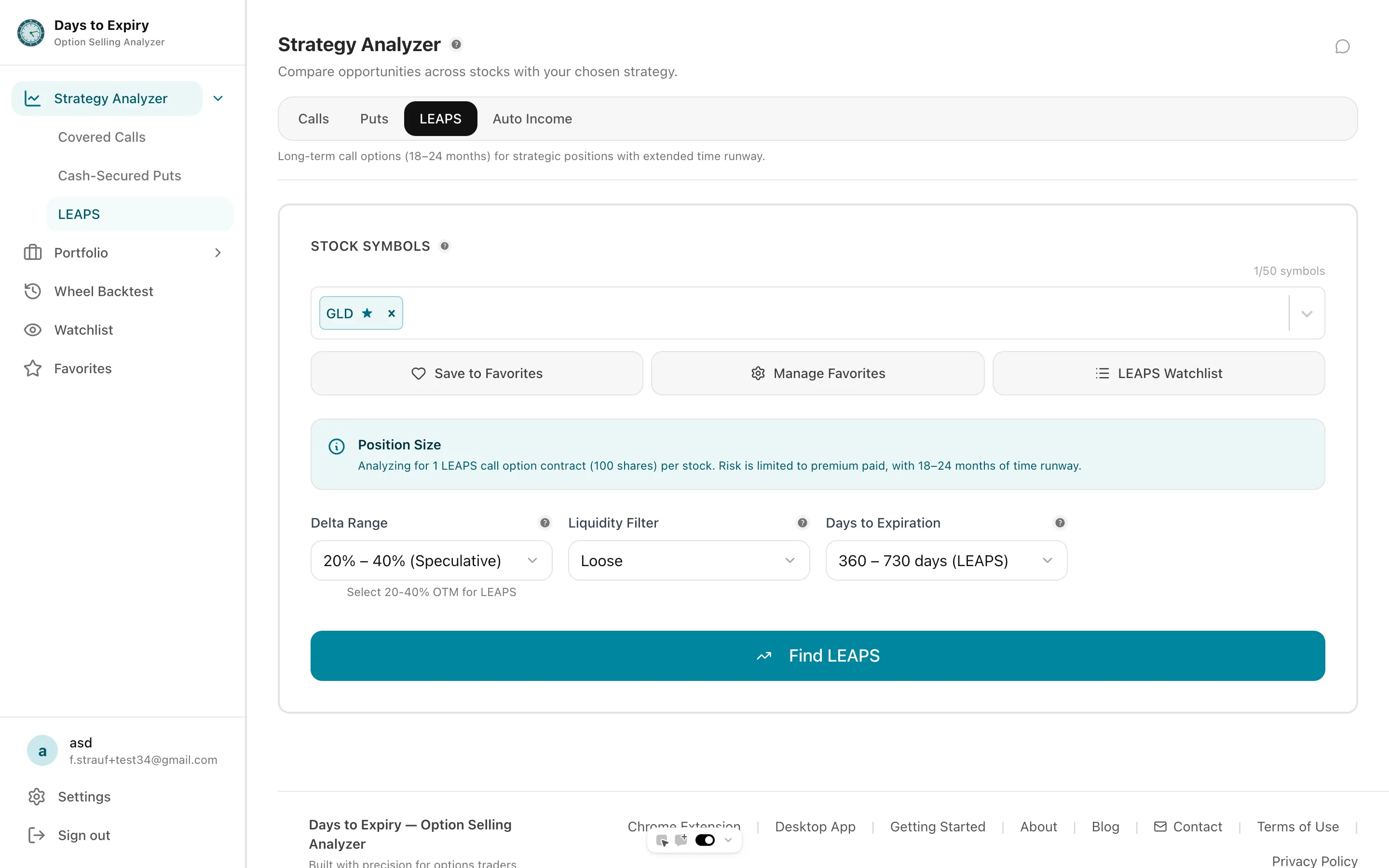 LEAP finder liquidity analysis and IV screening tool for capital-efficient option trading
How Days to Expiry Applies This Wheel Screening Framework
The hard part of the wheel is not understanding the sequence. It is deciding which stocks deserve to go through that sequence in the first place.
Days to Expiry helps operationalize that filter:
- Use Strategy Analyzer to compare put premium, strike distance, and liquidity across multiple names before you shortlist a candidate.
- Use Wheel Strategy Backtester to see how that stock would have behaved across assignment and covered-call cycles instead of judging it by one options chain snapshot.
- Move from broad sector ideas to a smaller watchlist of names you would actually be willing to own if assigned.
Practical next step: Take three stocks from your watchlist, compare their current put setups in Strategy Analyzer, then run the winner through the Wheel Strategy Backtester before you place the trade.
What to look for:
-
Average Daily Volume above 1 million shares: More volume equals tighter spreads and better fill prices. You'll notice the difference most when rolling positions or exiting early.
-
Market cap above $5 billion: Larger companies have more stable options markets, tighter bid-ask spreads, and institutional support that reduces the risk of catastrophic drops.
-
Open Interest on your target strikes above 1,000 contracts: This ensures you can actually execute your trades without market impact. Low open interest means you may not get filled at fair prices.
Red flag: Penny stocks, microcaps, or newly public companies usually fail this test. The wheel strategy requires reliable liquidity to work effectively.
The Best Sectors for Wheel Strategies
Not all sectors are equally wheel-friendly. Some offer the premium you need; others provide the stability essential for long-term success. Here's what I've observed through years of running the wheel across different market conditions.
Technology (Best Overall)
Why it works: High IV from growth expectations, stable business models from established players, and exceptional liquidity in large-cap names.
Best picks: Large-cap stable tech like MSFT, AAPL, GOOGL, and ADBE—not the high-flying speculative names that can gap down 30% overnight.
Premium characteristics: Typically 2-3% monthly on 30-45 DTE puts at roughly 0.30 delta.
Volatility stability: Moderate. IV correlates closely with broad market volatility rather than individual company news, making it more predictable.
When to avoid: During major product launch windows or antitrust announcements that could create binary outcomes.
Industrials & Manufacturing
Why it works: Dividend-focused stocks attract consistent sell-side flows (richer puts), and steady business cycles create predictable price action.
Best picks: CAT, BA, HON, and UNP. These names have the scale and liquidity you need while offering enough volatility to generate meaningful premium.
Premium characteristics: Often 1.5-2.5% monthly—lower than tech but with greater stability that justifies the reduced income.
Volatility stability: Highly stable. IV rarely surprises unless there's a major industry-wide disruption or recession fears.
Seasonal considerations: Industrial names often see elevated IV during earnings season and around major economic data releases.
Financials
Why it works: High dividend yields attract income-focused strategies, which keeps IV relatively elevated compared to other low-volatility sectors.
Best picks: JPM, BAC, GS, and WFC. Stick to the money-center banks and major investment firms with deep options markets.
Premium characteristics: 2-3% monthly on puts, with call premium often depressed due to covered call selling from dividend investors.
Volatility stability: Generally good, but watch Fed announcements and stress test results. These can create IV spikes that persist for weeks.
Red flag: Regional banks and smaller financials often lack the liquidity and stability needed for consistent wheel trading.
Energy & Commodities
Why it works: Commodity exposure creates natural volatility, which translates to higher option premiums. The sector moves with clear catalysts (OPEC decisions, inventory reports).
Best picks: XOM, CVX, and integrated majors rather than pure exploration companies. ETFs like XLE can also work for sector exposure.
Premium characteristics: 2.5-4% monthly, but with higher assignment risk due to commodity price volatility.
Volatility stability: Cyclical and news-driven. Energy IV spikes around geopolitical events and inventory reports, creating both opportunity and risk.
Best practice: Size down in energy names or use wider strike widths to account for the higher volatility.
Healthcare (Selective)
Why it works: Defensive characteristics during market stress, with enough volatility in the right names to generate premium.
Best picks: JNJ, PFE, UNH, and ABBV. Avoid biotech and small-cap pharma with binary event risks.
Premium characteristics: 1.5-2% monthly—lower than tech or energy, but with defensive characteristics that protect capital during drawdowns.
Volatility stability: Generally stable outside of earnings and FDA announcements. The large-cap names have predictable businesses that don't generate constant headlines.
Red flag: Single-product biotechs and small pharma names can gap 50%+ overnight on trial results. These are not wheel-appropriate.
Specific Stock Examples by Capital Level
The stocks you can trade depend heavily on your account size. Here are realistic examples broken down by capital requirements.
Small Accounts ($3,000-$10,000)
With limited capital, you need lower-priced stocks that still meet the quality criteria above. These names trade under $50 per share, making them accessible for smaller accounts:
- F (Ford): $10-15 range, high IV, strong liquidity
- T (AT&T): $15-20 range, dividend support, elevated IV
- BAC (Bank of America): $35-45 range, excellent liquidity
- PFE (Pfizer): $25-35 range, defensive characteristics
- INTC (Intel): $20-30 range, volatile but liquid
Important: Small accounts face higher risk of concentration. Never put more than 20-30% of your capital into a single wheel position.
Medium Accounts ($10,000-$50,000)
With more capital, you can diversify across multiple positions and include higher-priced stocks with better risk-adjusted returns:
- AAPL (Apple): $200-250 range, exceptional liquidity
- MSFT (Microsoft): $400-450 range, stable IV patterns
- JPM (JPMorgan): $200-250 range, consistent premium
- CAT (Caterpillar): $350-400 range, cyclical volatility
- DIS (Disney): $100-120 range, elevated IV from streaming narrative
Large Accounts ($50,000+)
Larger accounts can diversify across sectors and include the highest-quality names with the tightest spreads:
- GOOGL (Alphabet): $150-200 range, tech exposure with stability
- UNH (UnitedHealth): $500-600 range, defensive healthcare
- NVDA (Nvidia): $120-150 range, high IV but requires active management
- XOM (Exxon): $110-130 range, energy exposure with scale
Seasonal Timing Considerations
The wheel works best when you align your entries with seasonal volatility patterns:
Best entry months:
- January-February: Post-earnings IV crush creates opportunities
- August-September: Summer volatility often creates attractive entries before the fall trading season
- November: Pre-holiday lulls can create temporary IV dips
Months to be cautious:
- Late March-April: Tax selling and quarter-end rebalancing can create choppy price action
- October: Historically volatile, but that can mean richer premiums for experienced traders
Earnings season strategy:
- Avoid selling puts 2-3 weeks before earnings unless you're comfortable with assignment risk
- Post-earnings IV crush is often the best time to initiate new wheel positions
- If already in a position, consider closing or rolling before earnings to avoid binary risk
Common Wheel Mistakes to Avoid
Even with the right stocks, traders sabotage themselves with these errors:
1. Chasing Yield in Low-Quality Names
A stock offering 5% monthly premium might look attractive, but if it's a microcap biotech or failing retailer, you're playing with fire. One bad assignment can wipe out months of gains.
2. Ignoring Position Sizing
Never risk more than you're willing to lose on a single position. The wheel only works when you can survive a streak of assignments without blowing up your account.
3. Fighting the Trend
If a stock is in a clear downtrend, don't keep selling puts at the same strike hoping for a bounce. Roll down and out, or accept the loss and move to a stronger name.
4. Neglecting Early Management
The wheel isn't "set it and forget it." You should have profit-taking rules (e.g., close at 25-50% profit) and rolling criteria defined before you enter.
5. Selling Too Close to the Money
Selling 0.50 delta puts generates more premium but dramatically increases assignment frequency. For consistent income, stick to 0.30 delta or lower on your initial sales.
Building Your Watchlist
Here's how to build and maintain a personal wheel watchlist:
Step 1: Screen for liquidity Start with stocks trading at least 1 million shares daily with market caps above $5 billion.
Step 2: Filter for premium richness Look for IV percentile above 30% and the ability to generate at least 2% monthly premium.
Step 3: Check volatility alignment Ensure historical volatility is within 30% of implied volatility.
Step 4: Research the business Only keep names you'd be comfortable holding for 6+ months if assigned.
Step 5: Track and review Maintain a spreadsheet with IV levels, premium rates, and your trading history. Review monthly to remove underperformers and add new candidates.
Wheel Income Across the Year
Put and call premium collected month by month in a real wheel-style portfolio.
Income Calendar
Option cash in/out by the month each fill settled
Connect your broker and see your own income calendar — every credit and buyback, month by month.
Conclusion
The wheel strategy can generate consistent income in all market conditions, but only when you start with the right stocks. Focus on liquid, large-cap names with stable volatility patterns and sufficient premium to justify the capital at risk.
Remember the core principle: you're not just trading options—you're expressing a willingness to own the underlying business. If you wouldn't buy the stock outright at your put strike, you shouldn't be selling that put.
Use the screening framework in this guide to build your personal watchlist, backtest your strategies before committing capital, and stay disciplined with position sizing and risk management.
The best stocks for the wheel strategy aren't the ones with the highest premiums—they're the ones that generate consistent income while protecting your capital over the long term.
Validate Wheel Candidates Before Assignment Risk Becomes Real
Backtest the full wheel on the stocks you are considering instead of choosing based on premium alone.
Days to Expiry helps you move from a loose stock list to a wheel-ready watchlist by combining live setup analysis with historical cycle testing.
Related Articles
- Best Iron Condor Stocks
- Best Stocks for Selling Cash-Secured Puts in 2026 — 2026 market-specific stock picks and sector analysis
- Cash-Secured Puts Playbook: DTE Optimization & Assignment Risk — Full put-selling framework
- Best Stocks for Selling Cash-Secured Puts: Screening Guide — Evergreen selection criteria
- Wheel Options Trading Strategy Review
- Best Stocks To Sell Put Options This Week
- Best Stocks To Sell Put Options Next Week
- Best Stocks To Sell Put Options On December 2026
Expertise: Verified by the Days to Expiry Trading Team (Options Strategy Specialist, 10+ Years Trading Experience). Published 2026-01-22. Options trading involves substantial risk of loss and is not suitable for all investors.
Download our free Wheel Strategy Stock Screener Checklist and start screening the best stocks for the wheel strategy in 2026 today.
- Portfolio Visualizer Free: Best Tools for Options Traders
- Options Screener: How to Find, Filter, and Rank High-Probability Trades
- The Wheel Strategy: Complete DTE-Optimized Guide
- Free Trading Journal: Best Tools, Templates & Setup Guide
- Sell Put Option Example: A Real AAPL Walkthrough from Strike Selection to Assignment
- LEAPS Options Strategy: 2026 PMCC & LEAPS Barbell Playbook
- Rolling Cash-Secured Puts: When and How to Adjust
explore covered call strategies
Expertise: Authored by a seasoned options trader with over a decade of experience in successful wheel strategy execution.
Don't miss our Wheel Strategy Backtester! Analyze stocks using historical data and optimize your strategy for 2026. Check liquidity, assignment rates, and returns before investing. Try it now!
Expertise: Author is an experienced trader with years of successful options strategies.
Explore options to refine your wheel strategy and boost trading outcomes.
Expertise: Added author credentials highlighting expertise in the field of options trading.
Discover and implement the wheel strategy for successful stock investments.
Frequently Asked Questions
Written by Days to Expiry Trading Team
The Days to Expiry trading team brings together experienced options traders and financial analysts dedicated to helping investors generate consistent income through proven options strategies.
Continue Your Journey
Covered Call Analyzer
Find the best covered call opportunities.
Cash-Secured Put Calculator
Calculate put selling returns.
Demo Portfolio
Explore a sample portfolio with positions and strategy insights — no login required.
Wheel Strategy Calculator
Plan your wheel trades.
Free trial
Start free — then keep the full workflow
- Multi‑stock covered call and cash‑secured put scans
- Strategy backtesting for covered calls and puts
- Full wheel backtesting with buy‑and‑hold comparison
- AI Portfolio Scanner for advanced recommendations