
Assigned Options Tax Reporting: A Complete Guide to Premiums, Assignments & 1099-B
What is assigned options tax reporting? Assigned options tax reporting is how you document option exercises, assignments, and stock sales to the IRS. When assigned on a short option, your cost basis equals the strike price plus premiums received, which determines your capital gain or loss upon sale. Proper reporting ensures compliance and accurate tax calculations.
About the author: The Days to Expiry Trading Team includes Options Strategy Specialists with 10+ years of trading experience. Learn more about our team →
Struggling with assigned options tax reporting? This complete guide explains when options premiums are taxed, how assignments affect your cost basis, and why your 1099-B might not match your expectations.
Here's the confusion:
- You sell a cash-secured put for $0.50 premium. When is it taxed?
- You get assigned and buy 100 shares. Does that change your basis?
- You sell a covered call and it expires. Did you make income or capital gains?
- Your 1099-B says "sales proceeds" of $50,000 but you only made $3,000. What's going on?
This guide breaks down exactly when options are taxed, how different outcomes affect your cost basis, and why 1099-B reporting is messier than you'd expect.
Track your P&L automatically: Upload your broker statement to our IB Portfolio Analyzer to see realized gains, premium income, and trade history—making tax prep much easier.
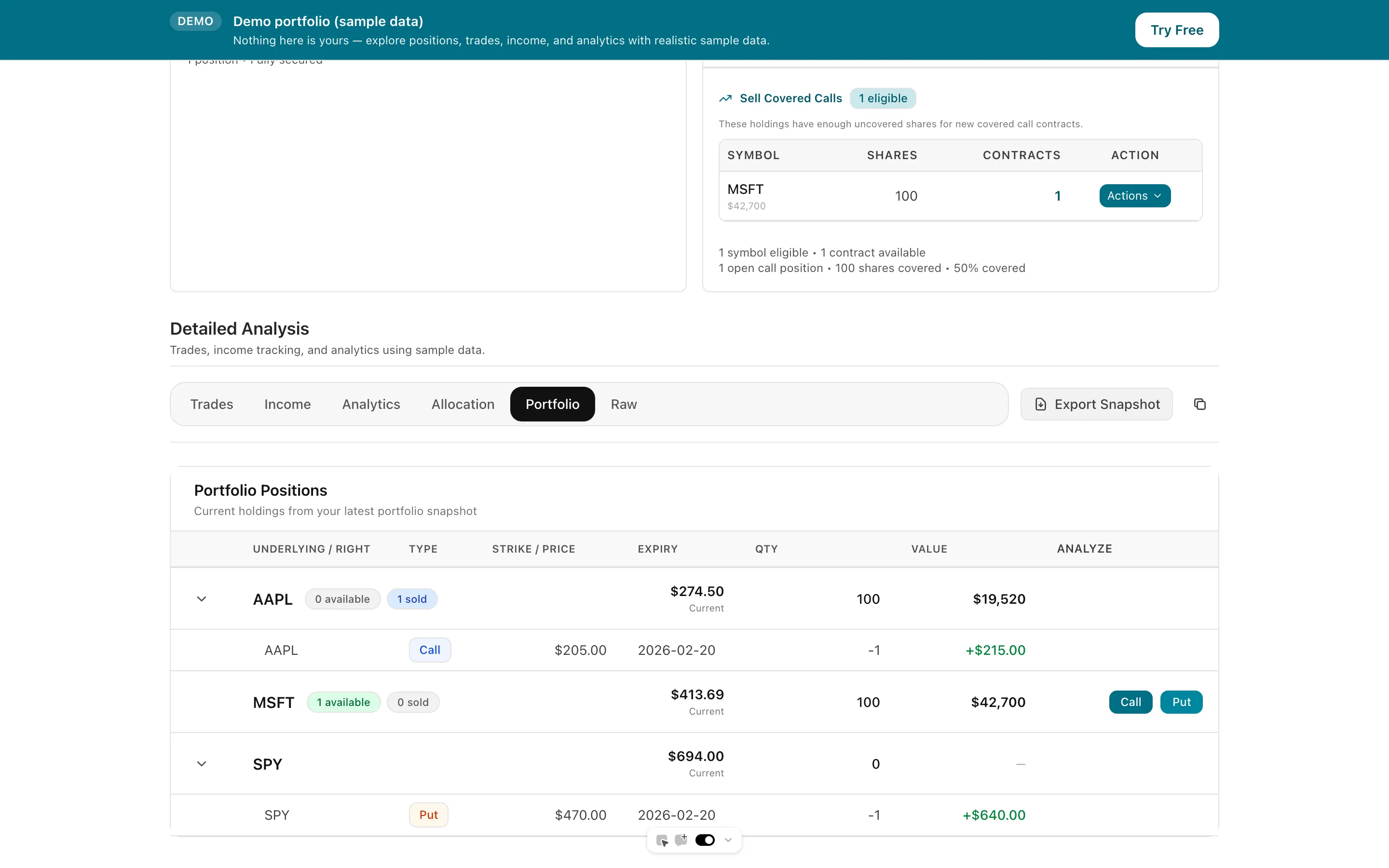 Dive deep into all trades of your IBKR portfolio with detailed transaction analysis
The Core Tax Principle: When Is An Option Taxed?
Here's the misconception: "I sold a put for $0.50 premium. That's income I need to report."
The reality: The $0.50 premium isn't taxed at the moment of sale. It's only taxed when one of three things happens:
- The option expires worthless (you keep the premium)
- You close the option (you sell it to someone else)
- The option is exercised/assigned (premium affects cost basis)
Let me explain each:
Scenario 1: Option Expires Worthless (You Win)
You sell a $420 SPY put for $0.50 premium (collect $50).
If SPY stays above $420 until expiration:
- The put expires worthless
- You keep the $50 premium
- Tax treatment: Short-term capital gain of $50
- When reported: On your 1099-B as a closed position (sale proceeds $0, cost basis $0.50, gain $0.50)
Scenario 2: You Close the Option Early
You sell a $420 SPY put for $0.50 ($50 collected).
Three days later, SPY is at $425, and the put is worth $0.25.
You decide to close it:
- You buy to close the put at $0.25 (you pay $25)
- Your profit: $0.50 - $0.25 = $0.25 ($25 profit)
- Tax treatment: Short-term capital gain of $25 (closed within 1 year)
- When reported: 1099-B shows sale proceeds (the buyback) and cost basis (the original sale)
Scenario 3: The Option Is Assigned (You Lose)
You sell a $420 SPY put for $0.50 ($50 collected).
At expiration, SPY is at $415 (below $420):
- Your put is assigned; you must buy 100 shares at $420
- Tax treatment: The premium ($50) reduces your cost basis for the stock
- Your cost basis: $420 × 100 = $42,000, minus $50 premium = $41,950 per share ($419.50)
- When reported: The assignment shows as a purchase (on your 1099-B or in your trade history); the premium is embedded in your cost basis
This is critical: The premium isn't a separate taxable event when assigned. It adjusts your purchase price.
How Is Premium Taxed by Strategy: The Three Outcomes?
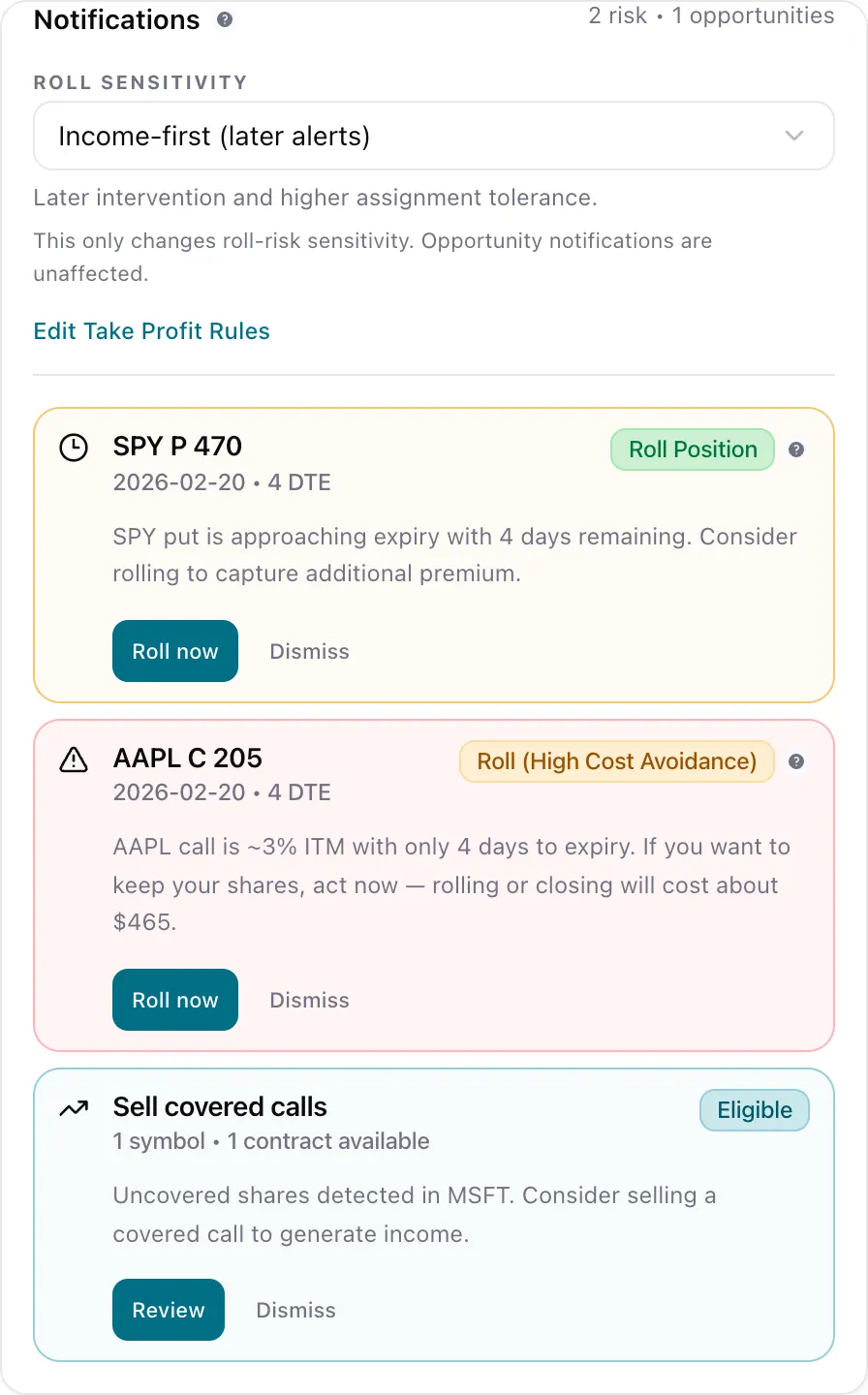 Assignment mechanics and execution process showing decision pathways
Cash-Secured Puts: Three Paths
You sell a $420 CSP for $0.50 premium.
Path A: Expires worthless (50% of the time, if you're skilled)
- Premium is taxed as short-term capital gain: +$50
- Cost basis: None (no stock owned)
- Net tax: Short-term gain of $50
Path B: You close it early (40% of the time, taking profits)
- You paid $0.25 to close; collected $0.50
- Premium gain: $0.25 = $25 profit
- Cost basis: None (no stock owned)
- Net tax: Short-term gain of $25
Path C: Gets assigned (10% of the time, you own the stock)
- You're forced to buy 100 shares at $420 strike
- Premium reduces cost basis: $420 - $0.50 = $419.50
- You own stock (cost basis $419.50 per share)
- No immediate tax; tax happens when you sell the stock later
- Net tax: Capital gain = (Sale price - $419.50) × 100
Important: In Path C, the premium isn't taxed in the year you sold it. It adjusts your basis, and tax occurs when you sell the stock.
Covered Calls: Assignment Changes Everything
You own 100 SPY at $415 cost basis. You sell a $430 call for $0.80 premium.
Path A: Call expires worthless (60% of the time)
- Premium is taxed as short-term capital gain: +$80
- Your stock cost basis stays at $415
- You still own the stock; can sell or sell another call
- Net tax in year 1: Short-term gain of $80 (from premium)
Path B: You close the call early (30% of the time)
- You bought back the $430 call at $0.40
- Premium gain: $0.80 - $0.40 = $0.40 = $40 profit
- Your stock is still yours, cost basis $415
- Net tax: Short-term gain of $40 (from premium closure)
Path C: Call is assigned (10% of the time, you lose the stock)
- You're forced to sell 100 shares at $430 strike
- Capital gain on stock: ($430 - $415) × 100 = $1,500
- Plus premium: $80 (now taxable as income)
- Total tax: Long-term or short-term capital gain of $1,500 + $80 = $1,580
- Holding period matters: If you owned the stock 1+ year, gain is long-term (favorable tax rate)
Critical difference from puts: When a call is assigned, the premium is added to your sale proceeds, and the stock is removed from your portfolio. The premium becomes taxable income in that year (not deferred like with puts).
Credit Spreads: Both Legs Count
Dive deep into all wheel trades of your IBKR portfolio with strategy-specific analysis
You sell a $420 put / buy a $418 put for $0.25 credit.
Path A: Both expire worthless (60% probability)
- Premium collected: $0.25 = $25
- You paid: $0 (nothing, you received a credit)
- Tax treatment: Short-term capital gain of $25
- Cost basis: None (no assignment, no stock)
Path B: Spread assigned (40% probability - puts are assigned, calls expire)
- You're assigned on the short put; forced to buy at $420
- The long put (protection) doesn't matter; it's exercised against the short put
- Net result: You're assigned at the spread width minus credit
- Cost basis: $420 - $0.25 = $419.75 per share (same as single put)
- Tax treatment: Assignment reduces basis; tax deferred until you sell stock
Path C: You close the spread early (common at 50% profit)
- You bought to close the entire spread for $0.12 (paid $12)
- You collected $0.25; paid $0.12 to close
- Net profit: $0.25 - $0.12 = $0.13 = $13
- Tax treatment: Short-term capital gain of $13
How Does the Assignment Chain Affect Cost Basis Through Multiple Rolls?
This is where options taxes get complicated. When you roll positions (close and reopen), your cost basis stacks up.
Example: Covered Call Rolling Chain
Week 1:
- Own SPY at $415 cost basis
- Sell $430 call for $0.80 (collect $80)
- Call expires worthless
- Tax: +$80 short-term gain (from premium)
- New basis: Still $415
Week 2:
- Sell new $435 call for $0.70 (collect $70)
- By day 5, call is worth $0.40
- You roll: Close call at $0.40 (pay $40), sell new $440 call for $0.65 (collect $65)
- Net on the roll: +$0.25 credit ($25 profit)
- Tax: Immediate +$25 short-term gain (from the roll transaction)
- New basis: Still $415 (stock not affected by rolls)
Week 3:
- Your $440 call gets assigned; SPY is at $442
- Stock is sold at $440 strike
- Capital gain: ($440 - $415) × 100 = $2,500
- Plus premiums: $80 + $70 + $65 - $40 (to close) = $175
- Total tax event: $2,500 (capital) + $175 (options income) = $2,675 total gain
But wait—the $175 in options gains were already partially taxed:
- Week 1: Taxed $80 (premium)
- Week 2: Taxed $25 (roll gain)
- Week 3: Taxed remaining $70 (from the final premium on assignment)
Accounting nightmare: Your 1099-B will show all these separately, making it hard to trace.
How Does Cost Basis Change With Assignment?
This is the most misunderstood part of options tax.
CSP Assignment: Premium Reduces Basis
You sell a $420 CSP for $0.50 premium (collect $50).
Assignment occurs:
- You buy 100 shares at $420 strike
- But you already collected $0.50 premium
- Adjusted cost basis: $420.00 - $0.50 = $419.50 per share
- Total basis: $41,950 for 100 shares
Tax implication: If you later sell at $430, your gain is:
- $430 - $419.50 = $10.50 per share = $1,050 gain
- Not $430 - $420 = $1,000 gain
The premium reduced your basis, so your gain is larger. This is good for you (more taxable gain today, but less cost basis) or bad (depends on your situation).
Covered Call Assignment: Premium Increases Proceeds
You own 100 SPY at $415. You sell a $430 call for $0.80 premium.
Assignment occurs; you sell at $430:
- Sale proceeds: $430 × 100 = $43,000
- Plus premium: $0.80 × 100 = $80
- Total proceeds: $43,080
- Cost basis: $415 × 100 = $41,500
- Capital gain: $43,080 - $41,500 = $1,580
The premium is added to sale proceeds, increasing your gain.
Wash Sale + Assignment: Cost Basis Adjustment
This is where things get really messy.
You sell a CSP at $420, collect $0.50. Market drops; put gets assigned.
Days later, you sell the 100 shares at $410 for a loss.
Loss calculation (before wash sale):
- Cost basis: $419.50 (after premium reduction)
- Sale price: $410
- Loss: $410 - $419.50 = -$9.50 per share = -$950
But wash sale rule applies if:
- You bought the same stock (via assignment) within 30 days
- You then bought it again within 30 days after the sale (inside the wash sale window)
If wash sale triggered:
- Your $950 loss is disallowed (deferred)
- Your cost basis for the repurchased shares increases by $950
- You don't get the tax deduction this year; it's pushed forward
What Will You Actually See in 1099-B Reporting?
Your broker (Interactive Brokers, Schwab, etc.) reports options trades on Form 1099-B.
How 1099-B Reports Options
For expired options:
- Box 1a (Proceeds): $0 (nothing sold; it expired)
- Box 1b (Cost basis): Premium collected (if a sale)
- Box 2 (Gain/loss): Premium (the expiration profit)
For closed options:
- Box 1a (Proceeds): Price you paid to close × 100
- Box 1b (Cost basis): Price you sold for × 100
- Box 2 (Gain/loss): Difference
For assigned options:
- Box 1a (Proceeds): Strike × 100 (for puts, this is a "purchase" shown as negative proceeds)
- Box 1b (Cost basis): Premium collected or paid
- Box 2 (Gain/loss): May be blank or show the premium gain/loss only
The problem: 1099-B treats options assignment like a stock sale/purchase. If you sold a $420 CSP and got assigned:
- 1099-B might show: Proceeds $42,000 (from the put exercise), Cost basis $50 (the premium), Gain/loss -$41,950
That looks like a massive loss! But it's not. It's just how the form is structured. The premium adjusts your basis for the stock you now own.
Interactive Brokers 1099-B Quirks
Interactive Brokers reports options in a specific way:
- Options that expired worthless: Listed as "closing" transactions with $0 proceeds and your premium as cost basis
- Options you closed early: Listed as closing sales
- Assignments: Listed as stock transactions (if puts, shown as purchases; if calls, shown as sales)
- Multiple rolls: Each close and open is separate, making your report long and confusing
IB tip: Download your Activity Statement (CSV) to see all transactions clearly. The 1099-B is derived from this, but the statement is easier to reconcile.
What Are the Tax Optimization Strategies for Options Traders?
Strategy 1: Time Your Assignment for Tax-Efficient Years
If you expect a high income year, rolling calls past December 31 means assignment happens in the next year (potentially at lower tax bracket).
Example:
- November: Your $430 call is assigned; SPY is at $432
- Normally: Assignment taxed in current year
- If you roll: Extend call 60 days; assignment happens in February (next year)
- Tax benefit: Deferral of $1,500+ gain to lower-income year
Risk: Market keeps running; you miss more upside.
Strategy 2: Use SPX (Section 1256) for Tax Advantage
SPX options get special tax treatment: 60% long-term, 40% short-term, even if held < 1 year.
Example comparison (SPY vs SPX):
SPY call (1 month, closed for $500 gain):
- Short-term capital gain
- Taxed at your ordinary income rate (37% top rate)
- Tax: $185 (on $500 gain)
SPX call (1 month, closed for $500 gain):
- Treated as 60% long-term / 40% short-term (Section 1256)
- 60% × 15% (long-term rate) + 40% × 37% (short-term rate)
- Tax: $60 (60% × 15% × $500) + $74 (40% × 37% × $500) = $134
- Tax savings: $51 per $500 gain (11% savings)
For active traders, this adds up.
Strategy 3: Tax Loss Harvesting in Options
Sell puts on stocks you want to own anyway, intentionally going for lower strikes to create assignment scenarios.
Example:
- You want to own QQQ at $350
- Sell $345 puts for $0.80 premium
- If assigned: You own QQQ at $344.20 (adjusted basis after premium)
- If not assigned: You keep $80 profit
Tax benefit: You either get your stock at a discount (reduced basis) or you get premium income.
How Do You Size Positions for Tax Efficiency?
Calculate Your Tax Bracket Impact
Before opening positions, calculate the tax impact:
Options gain after tax = Gain × (1 - Your tax rate)

Example:
- Sell 10 puts for $0.30 premium each = $300 gain
- Taxed as short-term capital gain
- Your tax rate: 32% (state + federal)
- After-tax gain: $300 × (1 - 0.32) = $204
- Real return: Not 100% of premium, just 68%
Adjust Position Sizing for Taxes
Most traders forget taxes and over-size. If you're targeting $500/month income from options:
Gross target: $500 Tax rate: 32% After-tax target: $500 × (1 - 0.32) = $340 Actual premium needed: $500 / 0.68 = $735
So you need to sell $735 worth of premium to net $500 after taxes.
What Are the Common Tax Mistakes Options Traders Make?
Mistake 1: Treating Premium as Income
Wrong: "I sold a put for $0.50 premium; that's $50 income."
Right: Premium is only taxed when the position closes (expiration, closure, or assignment). Until then, it's just received credit—not taxable income.
Mistake 2: Not Tracking Cost Basis Through Rolls
Wrong: Multiple rolls, no tracking; you don't know your real basis when assigned.
Right: Use a spreadsheet or platform to track adjusted basis through every roll.
Mistake 3: Ignoring Wash Sale Rules
Wrong: Close a losing put position; immediately sell a new put on the same stock.
Right: Wait 31 days or pick a different stock to avoid wash sale triggering.
Mistake 4: Taking Assignment Without Planning Taxes
Wrong: Get assigned on a call; surprised that you owe capital gains tax on the stock sale.
Right: Before opening covered calls, plan for the tax event. Calculate your gain/loss scenario.
Mistake 5: Forgetting About Short-Term vs Long-Term
Wrong: Assume all capital gains are long-term (15% rate).
Right: Options are almost always short-term (closed within 1 year). Long-term (20% rate) only if you hold underlying stock for 1+ years and sell via long-term holding, not via call assignment.
What Does Your Accountant Need From You for Options Trading?
When tax season rolls around, give your accountant:
- 1099-B forms from your brokers
- Activity statement (CSV) from Interactive Brokers (shows all transactions clearly)
- Spreadsheet of:
- Every cash-secured put (entry, exit, assignment)
- Every covered call (entry, exit, assignment)
- Realized gains/losses by strategy
- Any wash sale adjustments you made manually
- Cost basis tracking for stocks you own (especially assigned positions)
Which Platform Tools Help with Options Tax Tracking?
When using Days to Expiry or similar platforms:
Look for:
- Automatic cost basis calculation (especially for assignments and rolls)
- Tax lot tracking (which shares were bought via which assignment)
- Wash sale alerts (warn if you're triggering wash sales)
- 1099-B reconciliation (shows how your trades map to 1099-B reporting)
- Tax estimate (estimate your tax liability before year-end)
What Is the Bottom Line for the Options Tax Framework?
Tax-Aware Net Income Calculator
Calculate your true take-home income after taxes and fees. Understand the real yield on your option strategies.
Total premium collected before taxes/fees
Total capital securing positions
Short-term rate: 24% (most option premiums)
Transaction Fees
Fee impact: 0.2% of gross income
Gross Income
$3,000
6% yield
Fees
-$7
Taxes (24%)
-$718
Net Income
$2,275
4.55% net yield
Tax Bracket Sensitivity Analysis
| Tax Region | Tax Rate | Net Income | Net Yield |
|---|---|---|---|
| Federal (22%) | 22% | $2,335 | 4.67% |
| Federal (24%)(Current) | 24% | $2,275 | 4.55% |
| TX/FL (No State) | 24% | $2,275 | 4.55% |
| Federal (32%) | 32% | $2,036 | 4.07% |
| Federal (35%) | 35% | $1,946 | 3.89% |
| NY (High) | 35% | $1,946 | 3.89% |
| CA (High) | 37% | $1,886 | 3.77% |
Shows how your net income changes across different tax jurisdictions
Tax Disclaimer: This calculator provides illustrative estimates only. Tax treatment varies by jurisdiction, income level, and individual circumstances. Consult a qualified tax professional for personalized advice. Options premiums are typically taxed as short-term capital gains in the US.
Discover real options to generate tax-efficient income
Key takeaways:
-
Premium is not taxed at sale; it's taxed at outcome:
- Expiration = short-term gain
- Closure = short-term gain
- Assignment = cost basis adjustment
-
Assignment changes your basis, not immediate income:
- CSP assignment: Premium reduces cost basis
- Covered call assignment: Premium adds to sale proceeds
- Both defer the tax until you exit
-
1099-B is confusing because it treats options like stock:
- Expired puts show $0 proceeds, not what you collected
- Assigned puts show as stock purchases, not put expirations
- Multiple rolls create multiple line items
-
Short-term gains are taxed as ordinary income (37% top rate)
- Options are almost always short-term (unless underlying stock held 1+ year)
- SPX is exception: 60/40 long-term/short-term split (better tax treatment)
-
Tracking cost basis through rolls is critical
- Each roll adjusts your effective basis
- Without tracking, you'll overpay/underpay taxes
- Use a platform or spreadsheet
Bottom line: Understand the three assignment outcomes (expire, close, assign), know how your basis adjusts, and track everything meticulously. Taxes are complex, but predictable once you know the framework.
Related Articles
Master the tax and trading sides:
- SPX Options 60/40 Tax Treatment
- Options Trading Tax Calculator
- How Are Stock Options Taxed When Exercised? – Basis, holding period, and tax at exercise
- Fix IBKR 1099
- Interactive Brokers Tax Statement Guide for Options Traders – How to read your IB activity statement
- Form 1099-B for Options Traders: Interactive Brokers Walkthrough – Understanding your tax forms
- SPX Options Tax Treatment: Section 1256 Explained – Tax-advantaged trading
- Covered Call Tax Rules: Assignments, Cost Basis & Wash Sales – Covered call-specific tax scenarios
Expertise: author: name: 'Days to Expiry Trading Team' credentials: ['Options Strategy Specialist', '10+ Years Trading Experience', 'Tax Reporting Specialist']
Frequently Asked Questions
Written by Days to Expiry Trading Team
The Days to Expiry trading team brings together experienced options traders and financial analysts dedicated to helping investors generate consistent income through proven options strategies.
Continue Your Journey
Covered Call Analyzer
Find the best covered call opportunities.
Cash-Secured Put Calculator
Calculate put selling returns.
Demo Portfolio
Explore a sample portfolio with positions and strategy insights — no login required.
Wheel Strategy Calculator
Plan your wheel trades.
Free trial
Start free — then keep the full workflow
- Multi‑stock covered call and cash‑secured put scans
- Strategy backtesting for covered calls and puts
- Full wheel backtesting with buy‑and‑hold comparison
- AI Portfolio Scanner for advanced recommendations