
Options Assignment Probability Calculator: How Stock Option Probabilities Spread Over Time
Stock option probabilities spread over time as implied volatility, time decay, and strike distance interact. Near expiration, deep in-the-money options approach 100% assignment probability, while out-of-the-money options trend toward 0%. Understanding this distribution helps traders anticipate assignment risk and manage positions accordingly. how stock option probabilities spread over time?
Most traders answer: "Look at the delta—a 0.30 delta put has about 30% probability of expiring in-the-money."
But that's not quite right. And if you're using assignment probability to size positions or decide whether to roll, getting the answer wrong is expensive.
This guide explains how to calculate real assignment probability, why delta is a useful proxy but not the full story, and how to build a practical framework for managing assignment risk in your income trades.
See assignment probability in context: Our Strategy Analyzer displays assignment probability alongside premium, ROI, and delta for every option—helping you make informed decisions about risk vs. reward.
The Delta Myth: Why 0.30 Delta ≠ 30% Assignment Probability
The common misconception: "A 0.30 delta option has a 30% probability of expiring ITM."
Why traders believe this: Black-Scholes option pricing models use implied volatility, time, and price to calculate delta. In a random walk (assuming implied vol equals realized vol), delta roughly approximates the probability the option expires ITM.
Where it breaks down:
- Implied volatility != realized volatility. The market prices in volatility that may not occur.
- Assignment probability ≠ probability of expiring ITM. Options can be assigned early (before expiration).
- Dividends, interest rates, and corporate actions affect assignment probability independently of delta.
- The underlying isn't a random walk; it has momentum, support/resistance, and technical levels.
Real-world example:
You sell a $420 SPY put with 14 DTE:
- SPY is at $422
- 0.30 delta put at $420
- Implied volatility is 20% (elevated)
- "Delta says" 30% probability
In reality:
- Realized volatility over the last 5 days is 8% (quiet market)
- SPY has strong support at $418 (technical level)
- The $420 put is worth $0.45, but if vol drops to 15%, it's worth $0.30 (not $0.40 as delta suggests)
- True ITM probability: Maybe 22%, not 30%
Why this matters: If you size your position based on "30% assignment probability," but the real probability is 22%, you're over-sizing. When the market moves unexpectedly, you're caught off guard.
Understanding True Assignment Probability
Assignment probability has two parts:
- Probability of expiring ITM (the option ends up in-the-money at expiration)
- Probability of early assignment (the option is assigned before expiration)
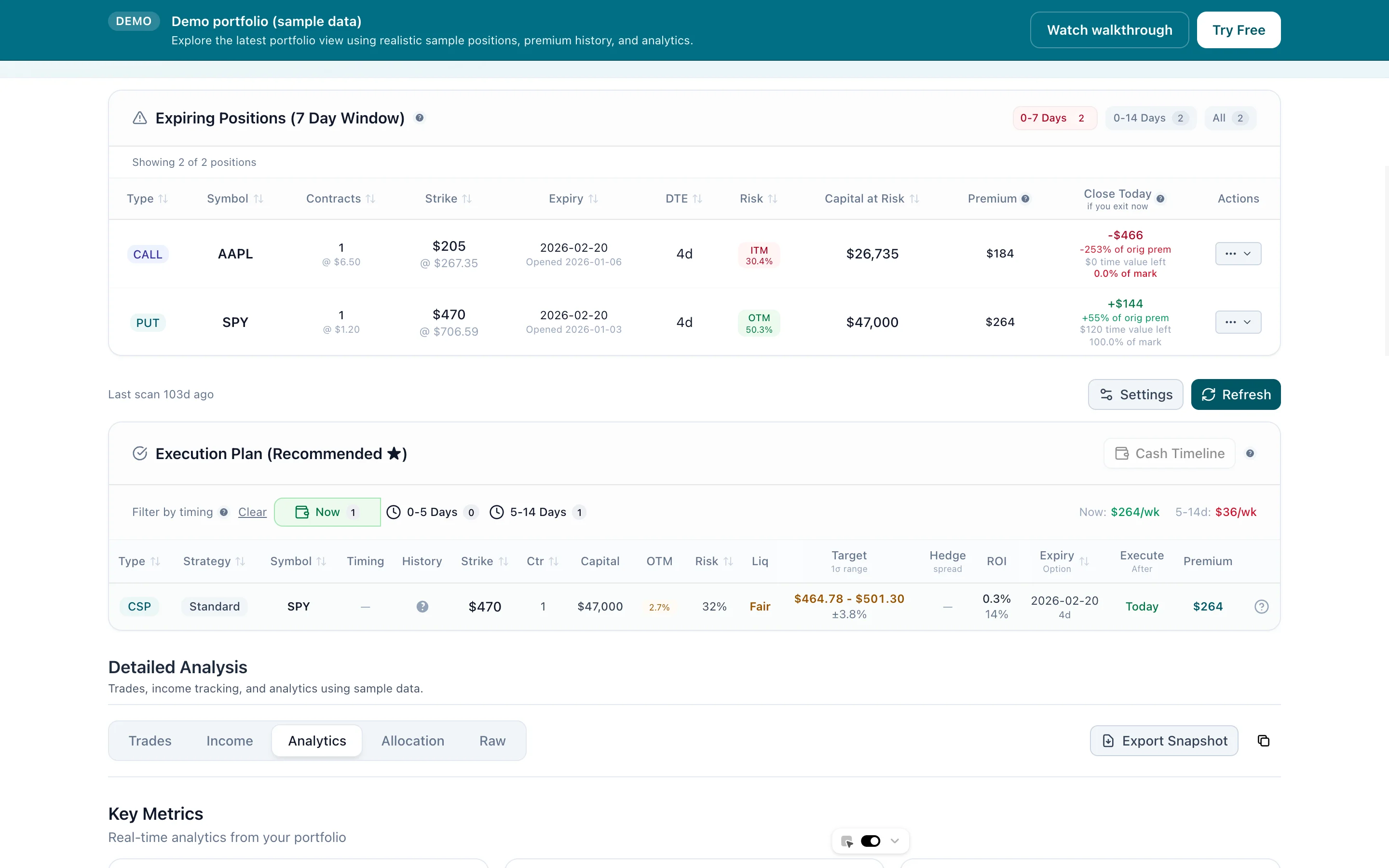 Roll decision analyzer tool showing assignment probability and timing across DTE stages
Part 1: Probability of Expiring ITM
This is what delta approximates—but with caveats.
Delta as probability (the Black-Scholes model assumes):
- 0.30 delta = 30% ITM probability (approximately)
- 0.50 delta = 50% ITM probability
- 0.70 delta = 70% ITM probability
Reality adjustments:
- If implied vol > realized vol, delta overestimates ITM probability (market is pricing in volatility that won't occur)
- If implied vol < realized vol, delta underestimates ITM probability
- If the underlying has momentum, delta misses it (random walk doesn't account for trends)
- Technical levels (support, resistance) matter more than randomness suggests
Practical adjustment to delta:
Adjusted ITM Probability = Delta × (IV Percentile Factor)

IV Percentile Factor:
- If IV > 70th percentile: Multiply delta by 0.85 (reduce probability estimate)
- If IV = 50th percentile: Multiply delta by 1.00 (delta is fair)
- If IV < 30th percentile: Multiply delta by 1.15 (increase probability estimate)
Example:
- Sell $420 SPY put (0.30 delta)
- IV percentile: 75% (high)
- Adjusted ITM probability: 0.30 × 0.85 = 0.255 = 25.5% (not 30%)
This is a rough adjustment, but it accounts for the fact that high IV prices in tail risk that may not materialize.
Part 2: Probability of Early Assignment
Early assignment typically happens in these scenarios:
| Scenario | When | Probability |
|---|---|---|
| Ex-dividend date | Stock goes ex-dividend, call holders exercise calls | HIGH - puts are rarely assigned; calls often are |
| Deep ITM puts | Put is $3+ below market | MEDIUM - usually let to expire; occasionally exercised for early premium capture |
| Deep ITM calls | Call is $3+ above market | HIGH - especially if dividend coming or expiration approaching |
| Regulatory/corporate action | Merger, delisting, special dividend | HIGH - forced assignment possible |
| Liquidity crunch | Bid-ask spreads spike, market is illiquid | LOW - most retail put sellers never experience this |
For cash-secured put sellers, early assignment risk is low. Here's why:
When you sell a put, the buyer pays upfront premium. If they exercise early, they:
- Pay you $420 per share (the strike)
- Get 100 shares
- Lose the remaining time value
They only do this if:
- The company goes ex-dividend (they want to capture the dividend)
- The put is severely ITM ($3+) and they want the shares at a discount
- Someone else forces exercise (rarely happens to retail traders)
For covered call sellers, early assignment is higher:
Call buyers will exercise early if:
- Your short call is ITM and you're about to go ex-dividend (they want the dividend)
- The stock is deep ITM and time value is gone
- Interest rates make early exercise valuable (rare in 2024-2025)
Conservative estimate for early assignment:
- 7-DTE call at 0.10-0.20 delta: ~5% early assignment risk
- 7-DTE call at 0.50 delta (ATM): ~2% early assignment risk
- 7-DTE call at 0.70 delta (ITM): ~15% early assignment risk
- 30-DTE call at any delta: <1% early assignment risk (time value too high)
Practical Assignment Probability: The Calculator
Here's a framework you can use to estimate assignment probability for your positions:
Step 1: Calculate Probability of Expiring ITM
Using delta directly (simple method):
ITM Probability ≈ Option's Delta
Example: 0.30 delta = 30% ITM probability
Adjusting for IV (slightly better method):
IV Percentile = (Days below current IV / Days in lookback period) × 100
IV Factor = 0.80 + (IV Percentile × 0.004)  // Ranges from 0.80 to 1.20

Adjusted ITM Prob = Delta × IV Factor
Example:
- Delta: 0.35
- IV percentile: 60%
- IV Factor: 0.80 + (60 × 0.004) = 1.04
- Adjusted ITM Prob: 0.35 × 1.04 = 36.4%
Step 2: Account for Early Assignment (Call Sellers Only)
If you sold a call:
Early Assignment Probability = 8% - (3% × Days to Expiration / 7)
// Approximation: 8% risk at 1 DTE, declining to ~0% at 7 DTE
Example:
- 3 DTE: 8% - (3 × 3/7) = 8% - 1.3% = 6.7% early assignment risk
- 7 DTE: 8% - (3 × 7/7) = 8% - 3% = 5% early assignment risk
Step 3: Calculate Total Assignment Probability
For puts:
Total Assignment Probability = ITM Probability + (1% early)
// Put early assignment is rare; usually <1%
Example:
- ITM probability: 30%
- Total assignment probability: ~31%
For calls:
Total Assignment Probability = ITM Probability + Early Assignment Probability
Example:
- ITM probability: 35%
- Early assignment risk: 6.7%
- Total assignment probability: ~42% (rough combined probability)
Real Examples: Calculating Assignment Probability
Example 1: Sell 0.30 Delta Cash-Secured Put
Setup:
- Current price: $420
- Sell $420 put (0.30 delta)
- DTE: 14
- IV percentile: 55%
Calculation:
Delta: 0.30
IV Factor: 0.80 + (55 × 0.004) = 1.00
Adjusted ITM Prob: 0.30 × 1.00 = 30%
Early assignment (puts): <1%
Total assignment probability: ~30.5%
Interpretation:
- 30% chance the put expires ITM (you get assigned at $420)
- 70% chance it expires OTM (the put is worthless, you keep premium)
- Planning: Assume 30% assignment; size accordingly
Example 2: Sell 0.40 Delta Covered Call (Bullish)
Setup:
- Current price: $130
- Own 100 shares at $130
- Sell $135 call (0.40 delta)
- DTE: 7
- IV percentile: 40%
Calculation:
Delta: 0.40
IV Factor: 0.80 + (40 × 0.004) = 0.96
Adjusted ITM Prob: 0.40 × 0.96 = 38.4%
Early assignment risk: 5% (7 DTE)
Total assignment probability: 38.4% + 5% = ~43.4%
Interpretation:
- 38% chance stock closes above $135 at expiration
- 5% chance you're assigned early before expiration
- ~43% total chance of assignment
- Planning: Accept that you have ~43% odds of selling shares at $135
Example 3: Sell 0.25 Delta Put Before Ex-Dividend
Setup:
- Current price: $150
- Sell $150 put (0.25 delta)
- DTE: 7
- Ex-dividend date: 4 days (before expiration)
- IV percentile: 70%
Calculation:
Delta: 0.25
IV Factor: 0.80 + (70 × 0.004) = 1.08
Adjusted ITM Prob: 0.25 × 1.08 = 27%
Early assignment (dividend scenario): +3-5% additional risk
Total assignment probability: 27% + 4% = ~31%
Interpretation:
- 27% chance of expiring ITM
- +4% boost for ex-dividend date risk (call buyers will exercise ITM calls to capture dividend)
- ~31% total assignment probability
- Planning: If you're uncomfortable owning 100 shares in 4 days, don't sell this put
Position Sizing Based on Assignment Probability
Now that you can calculate assignment probability, here's how to use it for sizing:
Rule 1: Never Size Assuming You'll Get Assigned
Wrong approach:
- "I sell a 0.30 delta put; only 30% chance of assignment; size to max profit if assigned"
Right approach:
- "I sell a 0.30 delta put; ~30% chance of assignment; size assuming I will be assigned (better to be pleasantly surprised)"
Rule 2: Capital Allocation by Assignment Probability
Allocate cash based on expected assignments:
Expected number of assignments per 10 puts at 0.30 delta: 3 assignments

If each assignment ties up $42,000 (100 shares × $420 strike):
Total cash needed: $42,000 × 3 = $126,000
If your account is $100,000, you can't run 10 puts at $420 strike; you'd run 7.
Rule 3: Assignment Probability as a Risk Filter
| Assignment Probability | Action |
|---|---|
| < 15% | Conservative; safe to size up |
| 15-30% | Moderate; balanced sizing |
| 30-50% | High; reduce position size or tighten stops |
| > 50% | Very high; consider not trading or using spreads instead |
Example: You want to sell puts on a stock. Your target is $42 strike, stock is at $45.
- $42 put (0.25 delta): ~25% assignment probability ✓ Trade it
- $44 put (0.50 delta): ~50% assignment probability ✗ Too risky; use spreads instead
DIY Assignment Probability Calculator (Spreadsheet)
Here's a simple spreadsheet formula you can use:
Inputs:
A1: Current Price
A2: Strike Price
A3: Days to Expiration
A4: Implied Volatility (as %)
A5: IV Percentile (0-100)
A6: Option Type (call or put)

Calculations:
Delta = [Your broker's delta or use Black-Scholes: roughly = 0.40 + 0.02 * (Strike - Price) / Price]
IV Factor = 0.80 + (A5 * 0.004)
Adjusted ITM Prob = Delta × IV Factor

If A6 = "call":
  Early Assignment Risk = 0.08 - (0.03 * A3 / 7)
  Total Prob = Adjusted ITM Prob + Early Assignment Risk
If A6 = "put":
  Total Prob = Adjusted ITM Prob + 0.01

Output: "Assignment Probability = [Total Prob]%"
Early Assignment Scenarios: When It Actually Happens
Scenario 1: Ex-Dividend, Short Call
You own 100 shares, short a $450 call (stock at $448)
What happens:
- Stock goes ex-dividend on Friday (2 days away)
- Dividend is $2 per share ($200 total for your 100 shares)
- Your $450 call is $2 ITM (intrinsic value)
- A call buyer would lose the $200 dividend if you own the shares
- Call holder exercises your call (forces assignment of your shares)
- You deliver shares, miss the $200 dividend, but keep the call premium
Assignment probability in this scenario: 80%+
How to avoid: Don't short calls right before ex-dividend dates if you want to capture the dividend.
Scenario 2: Deep ITM Put, Right Before Expiration
You sold a $420 SPY put (stock now at $400)
What happens:
- Put is $20 in-the-money (intrinsic value)
- Only 0.5 days to expiration
- Time value is $0
- A put buyer exercises early to lock in the intrinsic value
- You're assigned at $420, own 100 shares of SPY at $400 cost (you're underwater)
Assignment probability: Medium to High (30-50%)
Reality check: If the put is that deep ITM, you should have closed it days ago for a loss. Don't let puts get this deep ITM.
Scenario 3: Merger or Corporate Action
You're short calls on ACME Corp; it's announced as acquired
What happens:
- Stock is being acquired at $50/share
- Your short $48 calls are in-the-money
- Call holders exercise early to get the $50 acquisition price
- You're assigned, forced to deliver shares at $48 strike (missing the $2 upside)
Assignment probability: 100% (forced)
How to avoid: Track your positions for major corporate actions. If a position is involved in a merger, close it or be prepared for assignment.
Platform Features for Assignment Probability
When using Days to Expiry or similar platforms, look for:
Essential:
- Real-time delta display (to estimate ITM probability)
- IV percentile tracking (to adjust delta for vol extremes)
- Days to expiration countdown (to assess early assignment risk)
- Assignment probability calculator (if available; else calculate manually)
Premium:
- Assignment alert (notify when probability crosses a threshold)
- Ex-dividend calendar (highlight when early assignment risk jumps)
- Historical assignment data (show how often specific strategies get assigned)
The Bottom Line: Managing Assignment Probability
Key takeaways:
-
Delta ≈ ITM probability, not assignment probability
- A 0.30 delta put has ~30% chance of being ITM at expiration
- But assignment probability also includes early assignment (~1% for puts, 2-8% for calls)
- Total assignment probability: ITM prob + early assignment risk
-
IV percentile matters
- High IV (>70th percentile) reduces true ITM probability (market priced in volatility that won't materialize)
- Adjust delta downward in high-IV environments
-
Size positions assuming you'll be assigned
- Don't size based on "only 30% chance"
- Assume worst case; be surprised when it doesn't happen
-
Ex-dividend dates increase assignment risk
- For calls: buyers will exercise ITM calls to capture dividends (high assignment probability)
- For puts: rarely assigned on ex-dividend (assignment only if deep ITM)
-
Assignment isn't always bad
- Covered calls: assignment means shares sell at your target price (plan for it)
- Cash-secured puts: assignment means buying 100 shares at a planned price (size accordingly)
Most important: Understand assignment probability so you can plan for it, not be surprised by it. Size your positions assuming assignment will happen. Size your cash reserves accordingly. And never let a position get so deep ITM or OTM that you're trapped.
Related Articles
Master these strategies for complete assignment risk management:
- Sell Put Option Example
- What Is a LEAP Option? Long
- Call and Put Options Examples
- Cash-Secured Puts Playbook: DTE Optimization & Assignment Risk – Understanding assignment probability in CSP strategy
- Covered Calls by Expiration: Weekly vs Monthly Income Comparison – How DTE affects assignment probability in covered calls
- Options Greeks Explained: Income Trader's Guide – Delta and gamma interaction near assignment
- Rolling Covered Calls: When & How to Extend Positions – Managing assignments through rolling decisions
- When to Sell Options: Timing Signals & Entry Rules by Strategy
- Free Trading Journal: Best Tools, Templates & Setup Guide
Expertise: Days to Expiry Trading Team — Options Strategy Specialist & Quantitative Analysis
Frequently Asked Questions
Written by Days to Expiry Trading Team
The Days to Expiry trading team brings together experienced options traders and financial analysts dedicated to helping investors generate consistent income through proven options strategies.
Continue Your Journey
Covered Call Analyzer
Find the best covered call opportunities.
Cash-Secured Put Calculator
Calculate put selling returns.
Demo Portfolio
Explore a sample portfolio with positions and strategy insights — no login required.
Wheel Strategy Calculator
Plan your wheel trades.
Free trial
Start free — then keep the full workflow
- Multi‑stock covered call and cash‑secured put scans
- Strategy backtesting for covered calls and puts
- Full wheel backtesting with buy‑and‑hold comparison
- AI Portfolio Scanner for advanced recommendations