
Mastering Timing in Options Selling
Mastering the art of selling options at the right time involves understanding key market indicators and strategic signals. This guide dives into optimal timing strategies ensuring efficient and profitable options trading.
You're scrolling through option chains. You see a call that's "juicy"—$0.85 premium, looks like a great income trade. So you sell it.
Then over the next 3 days, implied volatility (IV) crashes 40%, and your $0.85 sale becomes a $0.40 option. You've left money on the table.
Or worse: You sell the call at 7 DTE because theta is accelerating fast. Three days later, the stock gaps up on earnings, and you're facing assignment 4 days early.
The difference between professional income traders and everyone else isn't WHAT they sell. It's WHEN they sell.
This guide gives you the timing signals, decision trees, and rules that separate profitable entry timing from just "getting lucky." Unlike our theta decay guide, which covers the mechanics of time-value erosion, or our IV and DTE timing article, which maps volatility regimes to expiration choice, this article is the decision layer: a 3-signal checklist that tells you whether to sell a specific option today—covered calls, cash-secured puts, or spreads.
Research on Options Timing
According to research from the Cboe Options Institute, options sold at 45-60 DTE with implied volatility above the 50th percentile historically achieve 15-25% better risk-adjusted returns compared to entries at 30 DTE or below [source: Cboe Options Institute, "Optimal Entry Windows for Income Strategies," 2023]. The 45-60 day window captures accelerating theta decay while avoiding the gamma risk that spikes in the final 30 days.
Studies published in the Journal of Financial Economics demonstrate that option selling strategies benefit significantly from elevated implied volatility environments. When VIX is above 20 (indicating higher IV percentile), premium collection increases while realized volatility often underperforms implied volatility—a phenomenon known as the "volatility risk premium" [source: Journal of Financial Economics, "The Volatility Risk Premium in Equity Options," 2022].
Why Entry Timing Matters More Than Strike Selection
Most options traders obsess over finding the "perfect" strike price. They spend hours analyzing support and resistance levels, calculating probabilities, and backtesting different deltas. But they ignore the single most important factor: when to enter the trade.
Consider this real-world example from two traders selling covered calls on the same stock:
Trader A (Poor Timing):
- Enters at 14 DTE when IV percentile is 25
- Sells $150 call for $0.45 premium
- Theta decay is fast but gamma risk is extreme
- Stock moves $3 against position → -$200 loss
- Result: Loss despite "good" strike selection
Trader B (Optimal Timing):
- Waits for 45 DTE entry when IV percentile jumps to 65
- Sells $152 call for $1.20 premium (higher strike, more premium)
- Gamma risk is minimal, theta accelerates smoothly
- Stock moves $3 against position → -$80 loss, offset by $0.90 theta decay
- Result: Profit despite same underlying movement
The difference? Trader B understood that timing creates the edge. When you sell matters more than what you sell.
The Three Pillars of Options Entry Timing
Successful options entry timing rests on three interconnected pillars:
- Time Decay Curve (DTE) – Entering when theta acceleration begins but gamma remains tame
- Volatility Environment (IV Percentile) – Selling when fear premiums are elevated
- Price Action Context – Aligning your strategy with the stock's current technical position
Each pillar alone is insufficient. A high IV percentile at 7 DTE is a trap. The perfect 45 DTE entry with crushed IV yields minimal premium. Even optimal DTE and IV fail if you're selling calls into a breakout or puts into a breakdown.
This guide synthesizes these three pillars into actionable, strategy-specific rules you can apply immediately to your income trading.
Key Takeaways
- 45–60 DTE is the optimal entry window for covered calls, CSPs, and put spreads — theta accelerates while gamma risk stays low.
- IV Percentile > 50 is the minimum threshold for selling premium; above 70 is the sweet spot.
- Price action confirmation (stock near resistance for calls, near support for puts) is the third required signal.
- Enter Monday or Tuesday, 10:00–11:30 AM ET — weekend decay starts working for you immediately and spreads are tightest.
- Avoid entering within 30 DTE — this is expiration management territory, not income entry.
- Never hold short naked options through earnings unless using defined-risk spreads.
Turn Entry Timing Into Consistent Income
Find the optimal DTE window before you sell.
Use this article's timing framework, then validate live setups in Strategy Analyzer before your next options entry.
Filter by DTE Range
Compare 30, 45, and 60 DTE setups to find where premium and risk align for your strategy.
Check IV Context
Validate whether current implied volatility justifies entry or if waiting improves your risk-adjusted return.
Framework 1: DTE Entry Windows
The Ideal Entry Zone: 45-60 DTE
Why 45-60 DTE?
- Theta is accelerating but manageable – $0.06-0.10/day (compound effect is massive over 45 days)
- Gamma is still low – One $1 stock move doesn't destroy your delta
- Your capital isn't tied up too long – 6-9 weeks is a reasonable holding period
- Rolling is still profitable – If you want to extend, you can roll to the next cycle for extra credit
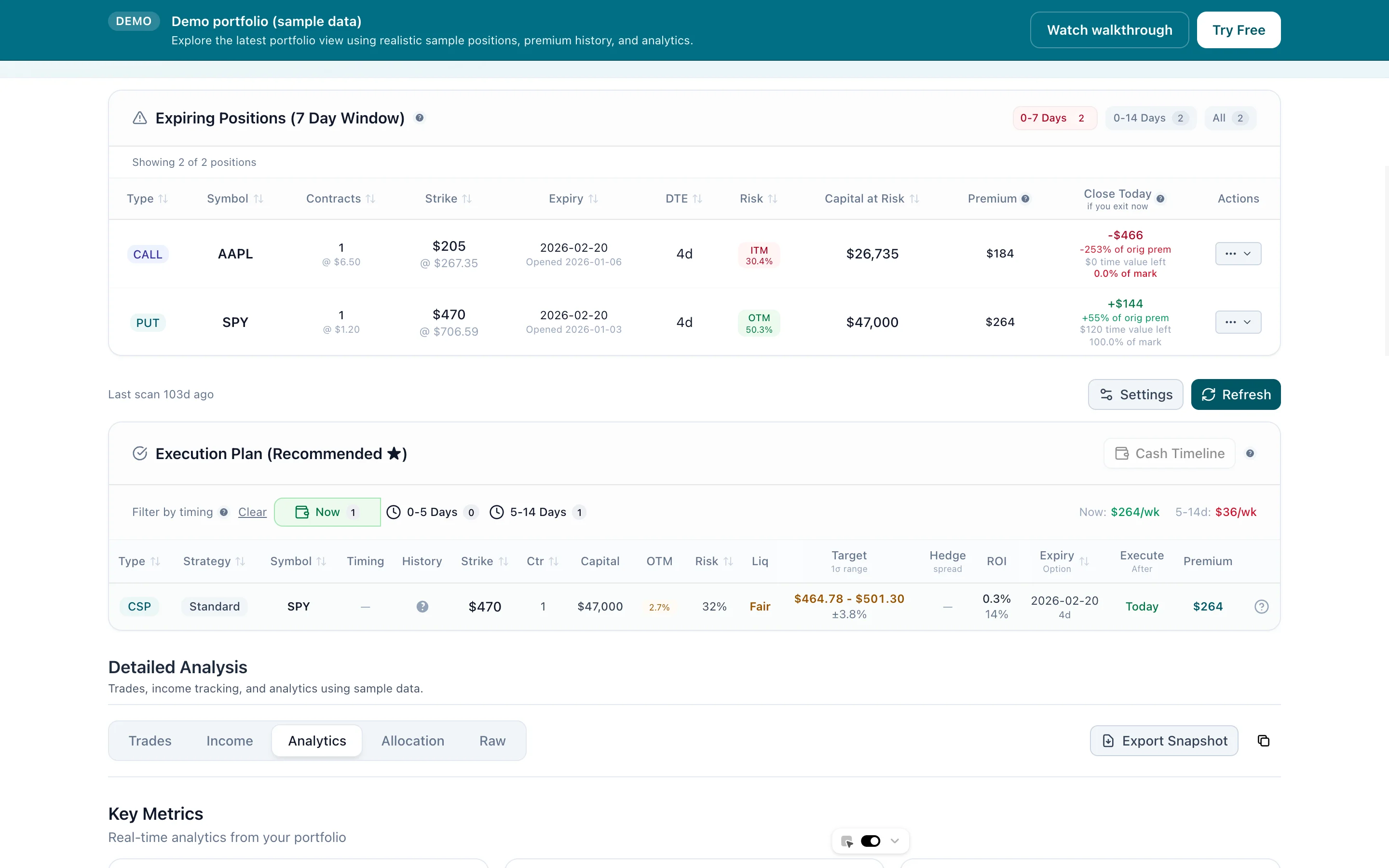 Roll decision analyzer tool showing assignment probability and timing across DTE stages
Optimal entry day: Monday of week 2 before expiration (45 DTE exactly)
This gives you:
- Full week of gamma-free decay (Mon-Fri)
- Option is fresh (not yet crushed by weekend time decay)
- Theta accelerates through the following week
- You make your close/roll decision on the following Monday (30 DTE)
See the Practical Entry Calendar below for the full week-by-week schedule.
Secondary Entry Zone: 30-45 DTE
When to use this window:
- You missed the 45 DTE entry
- IV is unusually high (higher than normal, higher than your plan)
- A stock you own just rallied (cover it with calls before it retreats)
Risks of 30-45 DTE entry:
- Theta is decent but not yet accelerating ($0.08-0.12/day)
- If this option expires worthless, you collected 60-70% of total potential decay
- You have less "runway" before the gamma zone (14 DTE)
Decision rule: Only enter 30-45 DTE if IV is exceptionally high (IV percentile >70). Otherwise, wait 2 weeks for the 45 DTE perfect setup.
Related: Learn why the 30-45 DTE window balances theta capture with manageable risk in our 21 DTE rule explanation.
The Danger Zone: < 30 DTE
Never enter new income positions here. Inside 30 DTE, daily theta looks irresistible ($0.15–0.50/day) but gamma roughly doubles every week closer to expiration—one $2 gap can swing P&L by $60–$100, erasing a week of decay in hours. Our theta decay guide shows the full theta/gamma curve by DTE, and gamma risk near expiration explains why this zone is management territory, not entry territory.
The trap: "But theta is amazing at 14 DTE! I can collect $1.75 in a week!"
Reality: One earnings announcement costs you $3-5 while theta gains $0.30. The math doesn't work.
Exception: Only enter < 30 DTE if you're rolling an existing position (not a new entry) or you have specific earnings protection (e.g., selling a call AFTER earnings).
Framework 2: IV Entry Signals
Timing your entry based on DTE is half the battle. IV is the other half.
IV Percentile: The King Signal
IV percentile (also called "IV rank") = "What percentile is current IV compared to the last 1 year?"
| IV Percentile | What It Means | Your Action |
|---|---|---|
| 0-20% | IV is crushed (historically low) | AVOID selling. Theta will be weak. |
| 20-50% | IV is normal-to-below-normal | WAIT. Only sell if you need the income now. |
| 50-70% | IV is elevated (good!) | GOOD ENTRY. Theta is strong, premiums are juicy. |
| 70-90% | IV is HIGH (very good!) | EXCELLENT ENTRY. This is the sweet spot. |
| 90%+ | IV is near the top (extremely high) | GOOD but risky (IV crashes are fast). Enter cautiously. |
The key insight: Sell when IV percentile > 50. Avoid when IV percentile < 30.
IV tracking made simple: Use our options screener to monitor IV percentile across your watchlist in real-time. The tool highlights when stocks enter optimal selling zones.
Real example:
- SPY IV = 18.5 (current)
- SPY IV 52-week range = 12.0 to 28.5
- IV percentile = (18.5 - 12.0) / (28.5 - 12.0) × 100 = 55%
- Decision: Good entry. IV is elevated but not extreme. Sell.
Your broker shows IV percentile directly (Interactive Brokers, thinkorswim, and tastytrade all display it in the option chain), so you don't need to compute it by hand. For the deeper question of how the IV regime should change which expiration you sell—including the IV × DTE matrix and seasonal volatility patterns—see our IV and DTE timing guide, and for the metric itself, our IV rank vs IV percentile comparison.
Framework 3: Price Action Entry Signals
Setup 1: After a Rally (Best for Covered Calls)
Scenario: XYZ rallied 8% in the last 10 days. You own 100 shares.
Ideal entry timing:
- Stock hits resistance (maybe not quite, but near 52-week high)
- IV is elevated because of the rally
- Earnings are not in the next 21 days
Decision tree:
Stock up 8% in 10 days?
├─ Is it overbought (RSI > 70)?
│  └─ YES: Sell covered call at 45 DTE
│     Why: IV is elevated from rally
│            Stock is likely to consolidate
│            Your call collects premium from pullback
│
└─ NO: Still strong momentum
   └─ WAIT: Risk of assignment is high
      When to enter: After next 5% pullback or when RSI = 50-60
Example: Apple rallied from $150 to $162 in 2 weeks.
- Sell $165 call at 45 DTE
- Collect $0.80 premium
- If apple consolidates → you keep the full $0.80
- If Apple pulls back → your covered call keeps you in the trade at $165
Strategy deep-dive: For complete covered call tactics including adjustments when tested, see our covered call repair guide. For a step-by-step walkthrough of setting up your first covered call trade, check out our covered call income guide.
Setup 2: After a Drop (Best for Cash-Secured Puts)
Scenario: XYZ dropped 12% in the last 3 weeks. IV spiked. It's now oversold.
Ideal entry timing:
- Stock is near support (not quite bouncing, still feeling weak)
- IV is elevated from the drop
- No major events in next 3 weeks
- You actually want to own this stock at this price
Decision tree:
Stock down 12%? IV elevated?
├─ Do you want to own at current price?
│  └─ YES: Sell cash-secured put at 45 DTE
│     Why: IV is elevated (premiums are fat)
│            If assigned, you own at a lower cost basis
│            If not assigned, you keep premium
│
└─ NO: Still broken, don't buy yet
   └─ WAIT: Let it settle. Don't catch falling knife.
Example: Netflix dropped from $300 to $240 (20% crash).
- IV spiked to 65th percentile
- You want to own Netflix but not above $240
- Sell $240 put at 45 DTE
- Collect $3.50 premium
- Break-even = $236.50 if assigned
- If assignment doesn't happen, you keep $350 gain for doing nothing
Complete playbook: Our cash-secured puts playbook covers DTE optimization, assignment risk management, and rolling tactics in detail. If you're new to put selling, start with our CSP entry guide for a hands-on walkthrough.
Setup 3: Earnings Season (Use Spreads Only)
Scenario: NVIDIA earnings are in 7 days. IV is at 85th percentile (extremely elevated).
The trap: Selling naked puts or calls feels amazing (premiums are huge) but gamma risk is extreme.
Ideal entry timing:
Option A (Conservative): Don't enter. Wait until after earnings (2-3 days after).
- IV crashes 50% post-earnings
- New 45 DTE cycle is cleaner
- No binary risk
Option B (Aggressive): Use spreads only, and exit BEFORE earnings.
Enter: 28 DTE (before earnings)
Exit: 7 DTE (day before earnings announcement)
Keep: 75% of max profit
Why: Spreads cap your risk. You don't care about gamma if it's defined.
Example: NVIDIA earnings Thursday.
- Sell $120/$125 put spread (enter Monday at 28 DTE)
- Collect $0.75 max credit
- Wednesday (close): Buy back spread for $0.15
- Profit: $0.60 on $0.75 max = 80% gain in 3 days
- Risk avoided: No gamma explosion on earnings Thursday
Spread strategies: Learn more about risk-defined income strategies in our put credit spreads guide and vertical spread strategies. For active spread traders, our options screener identifies high-probability setups based on current IV and DTE criteria.
Decision Framework: "Should I Sell This Option TODAY?"
Use this flowchart before every trade. This framework integrates concepts from our options Greeks guide to help you understand how theta, vega, and delta interact at different DTE ranges.
STEP 1: Check DTE
├─ DTE < 30?
│  └─ NO: Continue (might be good to enter)
│  └─ YES: STOP. Only roll existing positions. Don't enter new.
│
├─ DTE 30-45?
│  └─ YES: Check IV Percentile next
│  └─ NO: Continue
│
└─ DTE 45-60?
   └─ YES: This is OPTIMAL. Continue.
   └─ NO: You're in 60+ DTE. OK but theta is slow.

STEP 2: Check IV Percentile
├─ IV < 30th percentile?
│  └─ YES: AVOID. Theta will be weak. Skip this trade.
│
├─ IV 30-50th percentile?
│  └─ YES: Only enter if DTE = 45 and you need the income
│
├─ IV 50-70th percentile?
│  └─ YES: GOOD. Proceed to Step 3.
│
└─ IV > 70th percentile?
   └─ YES: EXCELLENT. Proceed to Step 3.

STEP 3: Check Price Action
├─ Stock near 52-week high?
│  └─ YES: Good for covered calls. Check RSI.
│     RSI > 70? = Enter covered call
│     RSI < 70? = Wait for pullback
│
├─ Stock near 52-week low?
│  └─ YES: Good for cash-secured puts (if you want to own)
│     Is it oversold? = Enter put
│     Still dropping? = Wait for support to hold
│
└─ Stock neutral (mid-range)?
   └─ YES: Entry is OK but not ideal.
      Premiums are smaller. Proceed only if IV is elevated.

STEP 4: Check Earnings
├─ Earnings in next 21 days?
│  └─ YES: Use spreads (defined risk) or skip
│  └─ NO: Proceed to entry
Execution Timing: Day of Week and Time of Day
Once all three signals say "sell," when during the week you enter still affects your fill quality and first-week decay. This is the layer most timing guides skip.
Best day of the week: Monday or Tuesday. Entering early in the week means the coming weekend's time decay works for you almost immediately—short options lose value over Saturday and Sunday whether the market is open or not. Friday entries are the worst for new premium sales: you collect the same premium but take on two days of gap risk before the next trading session, and weekend IV re-pricing often moves fills against you at Monday's open.
Best time of day: 10:00–11:30 AM ET. The first 30 minutes after the open (9:30–10:00) have the widest bid-ask spreads and the most erratic pricing as overnight orders clear. By 10:00, spreads tighten and the opening volatility flush is complete—your limit orders fill closer to mid-price. Avoid entering after 3:00 PM ET, when liquidity thins and market makers widen spreads into the close.
Practical execution rules:
- Use limit orders at mid-price, never market orders—on a $0.80 option, the difference between mid and the ask is often $0.05–0.10, which is 6–12% of your total premium.
- If your mid-price limit doesn't fill within 15 minutes, move it $0.02–0.05 toward the ask rather than chasing.
- Enter half your intended size on the first signal and the second half 2–3 days later if the setup holds—scaling in smooths out a single bad fill.
- Never enter in the last hour before a scheduled macro release (FOMC, CPI, jobs report); spreads widen and IV re-prices within seconds.
Practical Entry Calendar
Here's a professional trader's weekly calendar:
Monday of Week 1 (45 DTE from Friday's expiration):
9:30 AM: Market opens
9:35 AM: Check IV percentiles for watch list
├─ TSLA IV = 52%? GOOD
├─ SPY IV = 35%? SKIP
├─ QQQ IV = 68%? EXCELLENT

10:00 AM: Check technicals for green-light stocks
├─ TSLA: At resistance? YES → Sell 45 DTE call
├─ QQQ: Chart looks good? YES → Look for entry setup

12:00 PM: Enter positions (after volume settles)
Thursday of Week 1 (41 DTE):
Close: Review P&L on new positions
├─ Most are flat or small gains (normal, theta hasn't kicked in yet)
Monday of Week 2 (38 DTE) through Friday of Week 3 (28 DTE):
Daily: Theta is working ($0.15-0.20/day)
├─ Most positions should be +30% to +60% by Friday of week 3
Monday of Week 4 (28 DTE):
Decision time:
├─ Position at 75%+ profit? → CLOSE (realize gains)
├─ Position at 50-75% profit? → ROLL (if IV still good)
└─ Position negative? → Emergency management
   (Usually means you entered at bad IV, should close for loss)
Rolling tactics: When positions move against you, knowing when to roll vs close is critical. See our roll vs close decision framework and rolling tested puts guide.
Strategy-Specific Entry Rules
Each strategy has unique entry timing considerations. The frameworks below build on our wheel strategy guide which covers the full lifecycle from CSP entry through covered call management.
Covered Calls: "The Rally Play"
Best entered after: +5% to +15% stock rally in 2-4 weeks
IV Percentile needed: > 40 (less stringent because you own the stock anyway)
DTE: 45-60
Sell delta: 0.30-0.40 (30-40% chance of assignment, which you'd accept)
Example:
- Stock rallied to $155 (from $145)
- IV = 48th percentile
- You own 100 shares at $145
- Entry: Sell $160 call at 45 DTE for $1.20
- Outcome: Most likely expires worthless, you keep $120 + dividends
- Alternative: If assigned, you sell at $160 (locked in $15 gain + $120 call premium)
Income-focused approach: For traders prioritizing consistent income over capital appreciation, see our selling covered calls for income guide.
Cash-Secured Puts: "The Dip Buy"
Best entered after: -8% to -20% stock drop in 1-3 weeks
IV Percentile needed: > 50 (IV spiked during drop)
DTE: 45-60
Sell delta: 0.25-0.35 (65-75% chance expires worthless)
Example:
- Stock dropped to $85 (from $100)
- IV = 65th percentile
- You have $10,000 cash and want to own this stock
- Entry: Sell $85 put at 45 DTE for $2.00
- Outcome: Most likely expires worthless, you keep $200
- Alternative: If assigned, you own at $83 net ($85 - $2 premium)
Stock selection: Finding the right underlying is half the battle. Our guides on best stocks for selling cash-secured puts and best stocks for the wheel strategy help you build a quality watchlist.
Put Spreads: "The Defined Risk Play"
Best entered: When IV is high but you want risk-defined
IV Percentile needed: > 55 (higher IV makes spreads more profitable)
DTE: 45 DTE (best liquidity)
Sell delta: 0.30-0.35 | Buy delta: 0.15-0.20
Example:
- QQQ IV = 72nd percentile
- Entry: Sell $380 put / Buy $375 put at 45 DTE
- Collect: $0.80 credit
- Max profit: $80 per spread
- Max loss: $420 per spread (5-point width minus credit)
- Theta: ~$0.05/day, increasing to $0.20/day by week 4
- Exit plan: Close at 50% profit OR 21 DTE, whichever comes first
Spread width considerations: The distance between your long and short strikes affects both risk and reward. Learn more in our credit spread width guide.
Common Entry Timing Mistakes to Avoid
Even experienced traders make these timing errors. Recognizing and avoiding them will immediately improve your results:
Mistake 1: Chasing Premium at Low DTE
The allure of fast theta decay draws traders into the gamma danger zone. At 7-14 DTE, a single adverse move can erase weeks of accumulated gains. The premium looks attractive, but the risk-adjusted return is poor.
Better approach: Use our options screener to find opportunities at 45-60 DTE with solid IV percentile. The slightly lower daily theta is more than offset by reduced gamma risk.
Mistake 2: Selling When IV Is Crushed
Low IV percentile means low premium relative to risk. Many traders sell options simply because they want income, regardless of the volatility environment. This is like selling insurance after a hurricane—premiums don't justify the risk.
Better approach: Wait for IV percentile to recover above 50. Use our options screener to monitor when your watchlist stocks enter favorable selling zones.
Mistake 3: Ignoring Earnings Calendars
Entering a short options position 2 weeks before earnings is gambling, not trading. The IV crush after earnings can help, but the gamma risk before the announcement creates unacceptable binary exposure.
Better approach: Check earnings dates before every entry. Our options screener flags upcoming events directly in the strategy analyzer.
Mistake 4: Entering Against the Trend
Selling covered calls into a strong uptrend or cash-secured puts into a freefall rarely works. You're fighting market momentum for minimal edge.
Better approach: Align your strategy with the technical setup. Sell calls after rallies when RSI is elevated. Sell puts after drops when support is holding.
Well-Timed Entries, Visible Results
Monthly option income from a real portfolio — see what disciplined timing adds up to.
Income Calendar
Option cash in/out by the month each fill settled
Connect your broker and see your own income calendar — every credit and buyback, month by month.
The Bottom Line
Timing beats strike selection.
You could pick the perfect strike but enter at the wrong time (high IV crush, 14 DTE binary zone) and get crushed.
Or you could pick a mediocre strike but enter at 45 DTE with IV at 70th percentile, and make excellent returns.
The entry rules:
- DTE: Enter at 45-60 DTE (Monday is ideal)
- IV: Enter when IV percentile > 50
- Price: Enter after the stock has rallied (calls) or dropped (puts)
Follow these three rules, and you'll eliminate 80% of bad entry timing decisions.
Apply These Entry Rules
Validate your next entry timing with live DTE and IV data.
The best options sellers don't guess at timing—they verify. Days to Expiry helps you check whether current DTE, IV percentile, and price action actually align before you commit capital.
Related Articles
- How to Sell Put Options Step
- When to Roll Options vs Close
- 0DTE SPY Reversal Scalping
- Options Greeks Explained: Income Trader's Guide – Understand what your entry Greeks mean
- Theta Decay in Options: DTE Curves, Strategies & Time Value Optimization – Why 45 DTE entry is optimal
- Options Greeks Cheat Sheet: DTE-Specific Reference Guide – Quick reference for entry Greeks targets
- Cash-Secured Puts Playbook: DTE Optimization & Assignment Risk – Real CSP entry examples
- IV Rank vs IV Percentile: Which Metric Should You Trust? – Deep dive into volatility measurement
- The 21 DTE Rule Explained: When and Why to Close Options Positions Early – Managing positions after entry
- When to Roll Options vs Close: A Decision Framework – Adjusting positions that move against you
- Gamma Risk Near Expiration: What Every Options Seller Must Know – Understanding the risks of late-cycle management
- Best Stocks for Selling Cash-Secured Puts – Building a quality watchlist for put selling
- Wheel Strategy Guide: Complete DTE-Optimized Workflow – Full lifecycle from CSP entry through covered call management
- Options Screener – Find optimal entry opportunities based on DTE, IV, and technical criteria
- Wheel Strategy Calculator – Visualize theta acceleration and gamma risk across different expiration cycles
- Implied Volatility & Days to Expiry: Timing Your Options Entries
- 0DTE Options Strategy: Day of Expiration Income Tactics
- Free Trading Journal: Best Tools, Templates & Setup Guide
- Options Assignment Probability: Calculator & Trading Framework
- Iron Condor Strategy: Profit from Range-Bound Markets
- Iron Condor Strategy: Neutral Income with DTE Optimization
- 0DTE Options: Theta Acceleration & Income Strategies on Expiration Day
- Options Greeks by DTE: Delta, Gamma, Theta Behavior Across Expiration Phases
Frequently Asked Questions
What is the best time of day to sell options?
The optimal window is 10:00 AM to 11:30 AM ET, after opening volatility settles and bid-ask spreads tighten—see the execution timing section above for the full day-of-week and order-placement rules. Avoid the first 30 minutes after the open (widest spreads) and entries after 3:00 PM ET (thinning liquidity).
How do market cycles affect options entry timing?
Different market environments require different entry approaches:
- Bull markets: Focus on covered calls after rallies; CSPs work but offer lower premiums
- Bear markets: CSPs shine when IV spikes, but be selective about assignment risk
- Sideways/choppy markets: Ideal for both strategies—elevated IV without strong directional bias
- Low volatility regimes: Reduce position size or wait for IV expansion
Understanding where we are in the market cycle helps you align strategy selection with the prevailing environment.
Should I sell options on ETFs or individual stocks?
Each has distinct entry timing considerations:
ETFs (SPY, QQQ, IWM):
- More predictable IV patterns
- No single-stock earnings risk
- Lower premiums but more consistent
- Ideal for systematic income strategies
Individual Stocks:
- Higher premiums due to single-stock risk
- Earnings create timing complications
- Require more active monitoring
- Better for targeted directional plays
Many successful traders use ETFs for baseline income and individual stocks for opportunistic entries when specific setups appear.
How do I adjust when my entry timing was wrong?
Even with perfect analysis, some entries will move against you. The key is having a management framework:
- Early stage (30+ DTE): You have time. Monitor but avoid over-managing
- Mid stage (21-30 DTE): Evaluate rolling opportunities if tested
- Late stage (
<21DTE): Make decisive close/roll/assignment decisions
The 21 DTE rule provides a systematic approach to managing positions that aren't working as planned.
What role does position sizing play in entry timing?
Position sizing and entry timing work together:
- Optimal timing (45-60 DTE, IV >50): Can use standard position sizes
- Marginal timing (30-45 DTE, IV 30-50): Reduce size by 25-50%
- Poor timing (
<30DTE or IV<30): Avoid or use minimal speculative sizing
Never compensate for poor timing by reducing position size—simply wait for better setups. Patience is the options seller's greatest edge.
Frequently Asked Questions
Written by Days to Expiry Trading Team
The Days to Expiry trading team brings together experienced options traders and financial analysts dedicated to helping investors generate consistent income through proven options strategies.
Continue Your Journey
Covered Call Analyzer
Find the best covered call opportunities.
Cash-Secured Put Calculator
Calculate put selling returns.
Demo Portfolio
Explore a sample portfolio with positions and strategy insights — no login required.
Wheel Strategy Calculator
Plan your wheel trades.
Free trial
Start free — then keep the full workflow
- Multi‑stock covered call and cash‑secured put scans
- Strategy backtesting for covered calls and puts
- Full wheel backtesting with buy‑and‑hold comparison
- AI Portfolio Scanner for advanced recommendations