
Best Stocks for Poor Man's Covered Call in 2026
The best stocks for poor man's covered call (PMCC) LEAPS in 2026 combine liquid options, stable fundamentals, and reliable short-call income. This screening guide walks you through the criteria and top sector candidates. This guide walks through the key steps and practical considerations.
The key is finding stocks with three characteristics:
- High implied volatility (rich premiums for sold calls)
- Sufficient LEAPS liquidity (must be able to buy/sell LEAPS easily)
- Consistent stock fundamentals (to avoid assignment on deteriorating positions)
Let's dive into the screening criteria and my top 10 PMCC candidates.
Turn PMCC Screening Into a Candidate Shortlist
Days to Expiry helps you compare IV, LEAPS structure, and short-call income so you can narrow PMCC ideas before you tie up capital.
Use this screening logic to find promising names, then validate whether the actual LEAPS and short-call setup is good enough to justify the complexity.
Check LEAPS Quality
Compare liquidity, strikes, and capital requirements before you assume a stock is PMCC-ready.
Estimate Call Income
See whether the short-call premium is actually attractive relative to the long LEAPS cost.
Shortlist Better Names
Separate reliable PMCC candidates from low-liquidity names that only look good on paper.
Screen for PMCC candidates: Use the Strategy Analyzer to identify stocks with strong income potential and IV, helping you find PMCC-ready candidates and optimal short call strikes.
Watch the short
LEAPS Selection Criteria: The Foundation
Before you can even execute a PMCC, you need access to quality LEAPS options. LEAPS (Long-Term Equity Anticipation Securities) are options expiring 9-24 months out—perfect for the long leg of a poor man's covered call.
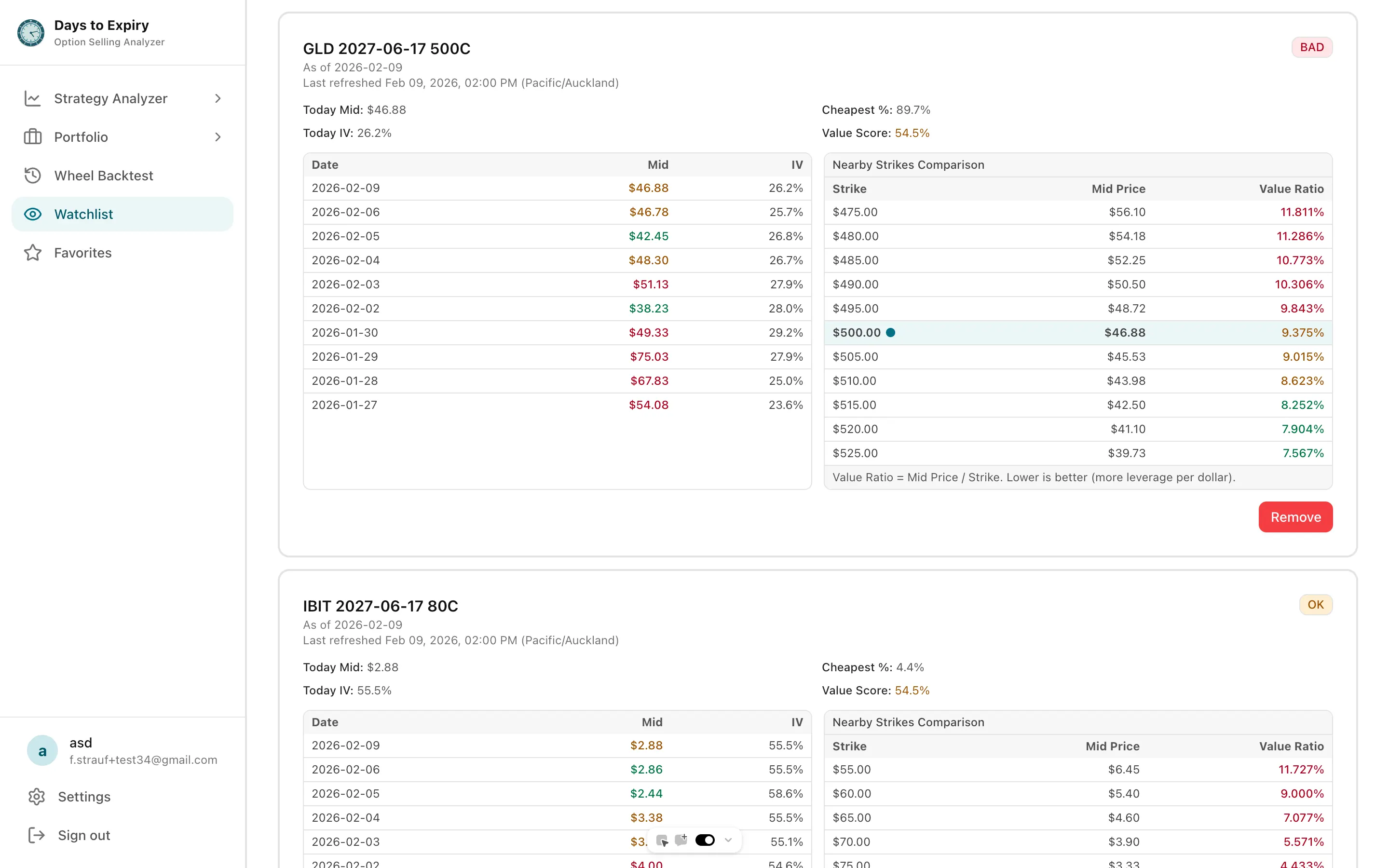 LEAPS portfolio management dashboard and PMCC position structure
1. LEAPS Liquidity Requirements
Bid-Ask Spread: Less than $0.15 for every $5 of premium
- Wide spreads eat into your profit margin
- Test by checking the ask price for 9-12 month LEAPS calls
Open Interest: Minimum 500 contracts
- Higher OI = tighter spreads and easier entry/exit
- Check which stocks have active LEAPS trading
Example: Apple (AAPL) LEAPS have excellent liquidity—you can often buy/sell with $0.05 spreads. Contrast this with a smaller cap biotech where LEAPS might have $0.50+ spreads. That's a red flag.
2. Strike Selection for LEAPS
The LEAPS call you buy should be:
- In-the-money (ITM) by 1-3% – provides downside protection and higher gamma
- Delta 60-75 – approximately 60-75% probability of being ITM at expiration (9-12 months out)
Cost Basis Example:
- Stock: AAPL at $230
- Buy LEAPS call: $235 strike, 12 months out, costs $15
- Effective cost basis: $250 per share (vs $230 cash on hand)
- Now sell shorter calls (30-45 DTE) to income on the position
This is where PMCC shines: you're paying $250 effective cost but earning premium every month.
3. Implied Volatility Percentile
Select stocks where IV percentile is at least 30-40% or higher.
- IV Rank 30-40%+ = better premiums on your sold calls
- IV Rank < 20% = thin premiums, not worth the complexity
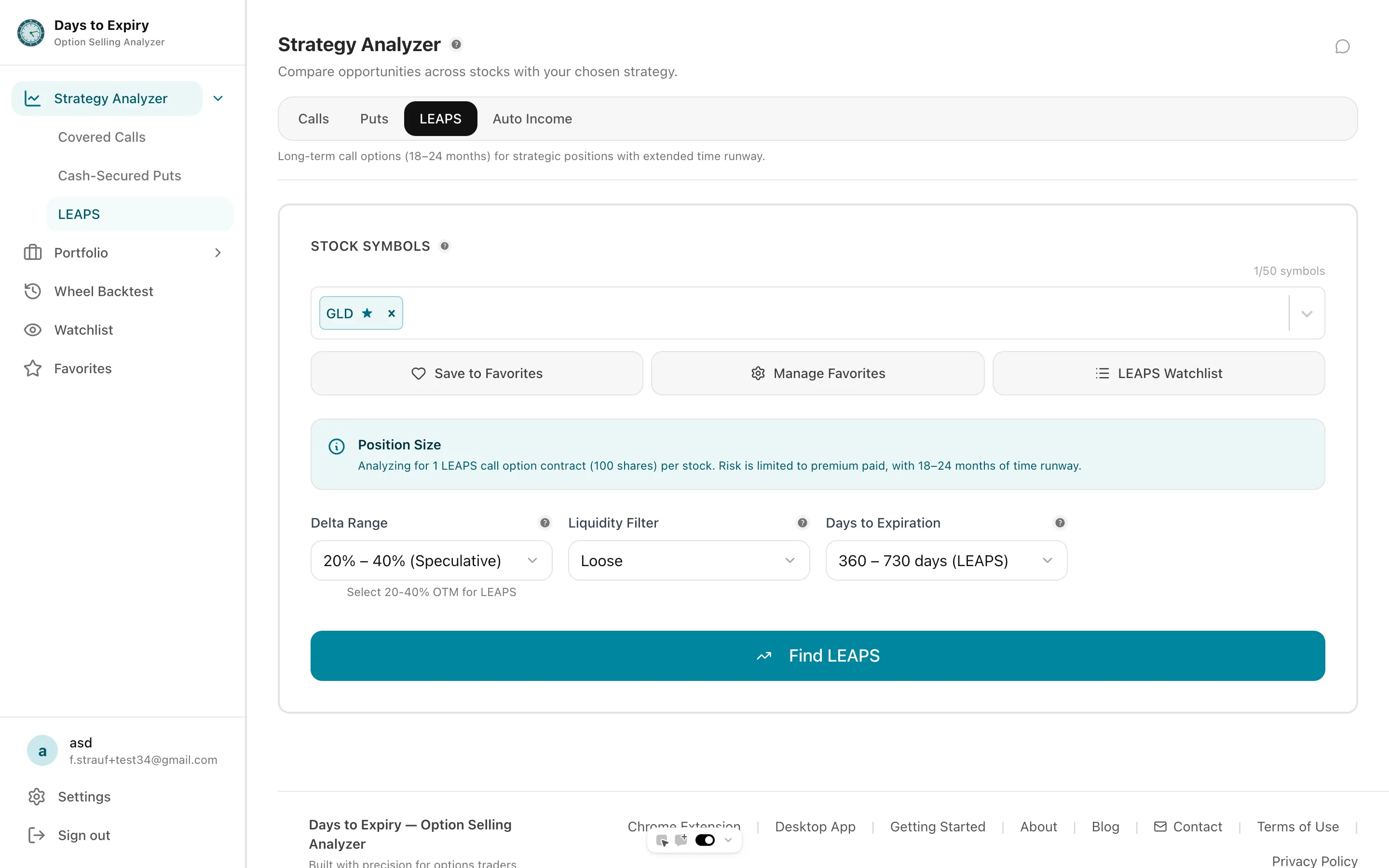 LEAP finder liquidity analysis and IV screening tool for capital-efficient option trading
Check IV percentile on your broker's tools or use IV Bank data:
- Fidelity: Active Trader Pro
- Interactive Brokers: Anywhere platform
- Tastyworks: Built-in IV percentile
How Days to Expiry Applies This PMCC Framework
PMCC setups look efficient on paper because they reduce capital requirements. The real question is whether the long LEAPS cost, short-call premium, and stock quality combine into a setup that is worth managing.
Days to Expiry helps bridge that gap:
- Use Strategy Analyzer to compare candidate names before you commit to pricing the LEAPS leg in detail.
- Pressure-test whether the short-call income is meaningfully better than simpler covered call or cash-secured put alternatives.
- Use Demo Portfolio to keep the strategy in context with the rest of your book rather than treating PMCC as a standalone idea.
Demo Portfolio Overview
Explore positions, trades, income, and analytics with realistic sample data.
Want to track your own portfolio? Import your trades and see analytics like this.
Practical next step: Pull three PMCC candidates into the Strategy Analyzer, compare their IV and short-call premium, then only price the LEAPS leg on the one that still looks attractive after that first filter.
Top 10 Stocks for PMCC: My 2025 Screening Results
I've screened stocks using these criteria:
- LEAPS available with <$0.15 spreads
- IV percentile ≥ 35%
- Average sold call premium: $0.50+ per contract (45-30 DTE)
- Strong fundamentals and dividend stability
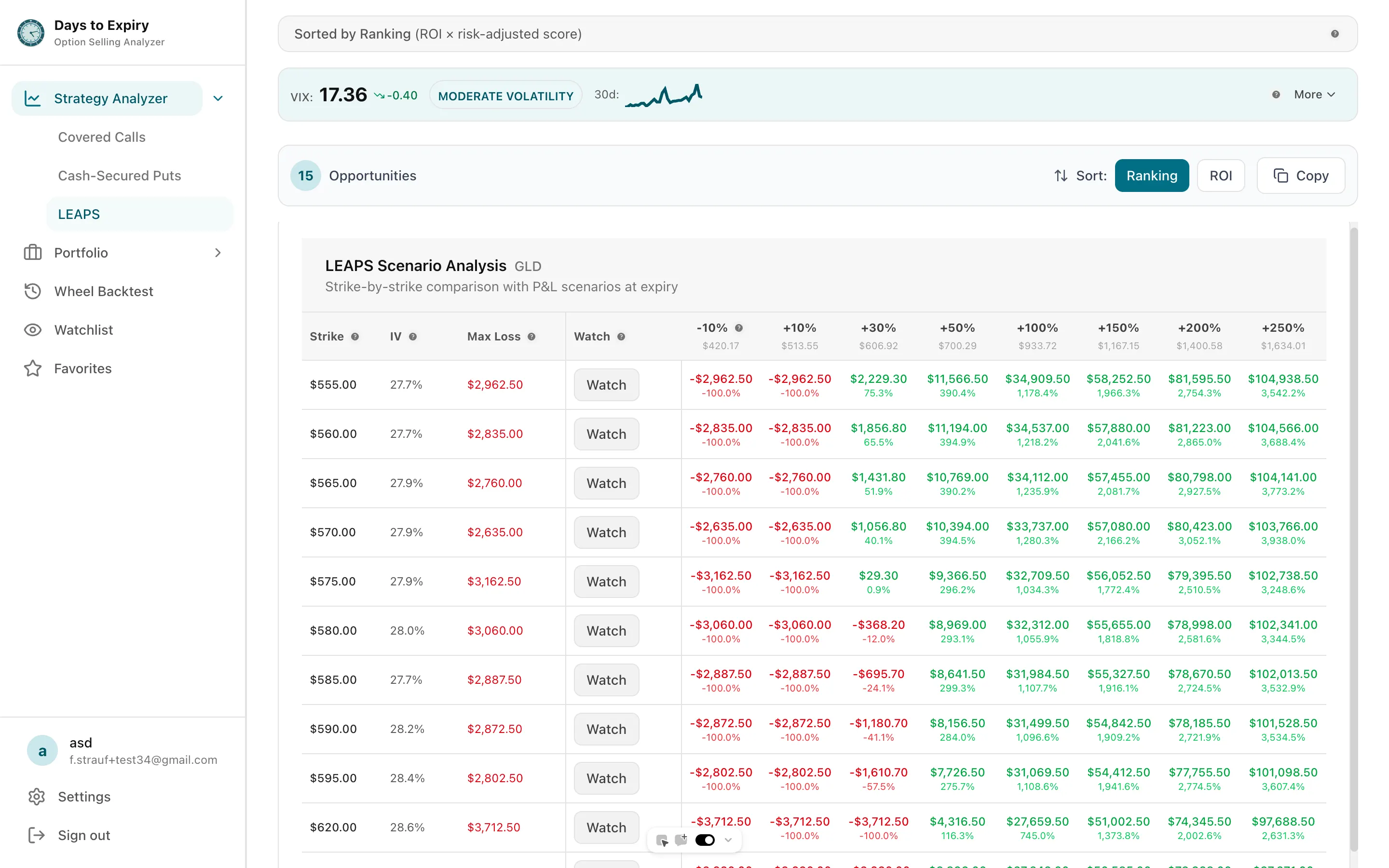 LEAPS backtesting results showing historical performance across different market conditions
Tech & Growth Sector
1. Apple (AAPL) – The Stable Income Generator
- IV Percentile: 42%
- LEAPS Strike: $240 (12 month, delta 65)
- LEAPS Cost: $15
- Monthly Call Premium (30 DTE): $0.45-0.65
- Annualized Income: 20-25%
- Why: Excellent LEAPS liquidity, consistent IV, stable stock behavior
2. Microsoft (MSFT) – Capital-Efficient Momentum
- IV Percentile: 38%
- LEAPS Strike: $420 (12 month, delta 62)
- LEAPS Cost: $18
- Monthly Call Premium (30 DTE): $0.50-0.70
- Annualized Income: 22-27%
- Why: Defensive tech exposure, strong premium generation, stable stock
3. Nvidia (NVDA) – Higher Premium, Higher Risk
- IV Percentile: 55%
- LEAPS Strike: $120 (12 month, delta 70)
- LEAPS Cost: $12
- Monthly Call Premium (30 DTE): $0.80-1.20
- Annualized Income: 32-48%
- Risk Factor: High volatility—assignments more likely
- Why: Excellent premium generation for aggressive PMCC traders
Finance & Dividend Sector
4. JPMorgan Chase (JPM) – Steady Dividend Support
- IV Percentile: 40%
- LEAPS Strike: $220 (12 month, delta 63)
- LEAPS Cost: $9
- Monthly Call Premium (30 DTE): $0.35-0.50
- Annualized Income: 28-33%
- Why: Dividend support limits downside risk, strong fundamentals
5. Wells Fargo (WFC) – Value Play with High Premiums
- IV Percentile: 45%
- LEAPS Strike: $85 (12 month, delta 65)
- LEAPS Cost: $5
- Monthly Call Premium (30 DTE): $0.25-0.35
- Annualized Income: 36-42%
- Why: Cheap LEAPS = small investment, percentage returns are attractive
Energy Sector
6. Chevron (CVX) – Dividend + Volatility
- IV Percentile: 48%
- LEAPS Strike: $165 (12 month, delta 62)
- LEAPS Cost: $8
- Monthly Call Premium (30 DTE): $0.40-0.60
- Annualized Income: 30-45%
- Why: Oil sector volatility creates premium opportunities
7. Exxon Mobil (XOM) – Similar Profile to CVX
- IV Percentile: 46%
- LEAPS Strike: $115 (12 month, delta 64)
- LEAPS Cost: $6
- Monthly Call Premium (30 DTE): $0.30-0.45
- Annualized Income: 36-45%
- Why: Lower LEAPS cost = accessibility for smaller accounts
Healthcare & Biotech
8. Pfizer (PFE) – Defensive Pharma
- IV Percentile: 35%
- LEAPS Strike: $30 (12 month, delta 62)
- LEAPS Cost: $3
- Monthly Call Premium (30 DTE): $0.20-0.30
- Annualized Income: 40-60%
- Why: Lowest LEAPS cost, best percentage returns
9. Merck (MRK) – Biotech Stability
- IV Percentile: 37%
- LEAPS Strike: $305 (12 month, delta 63)
- LEAPS Cost: $14
- Monthly Call Premium (30 DTE): $0.45-0.65
- Annualized Income: 23-28%
- Why: Stable pharma with consistent volatility
Consumer Discretionary
10. Amazon (AMZN) – Large Cap Growth PMCC
- IV Percentile: 41%
- LEAPS Strike: $210 (12 month, delta 64)
- LEAPS Cost: $16
- Monthly Call Premium (30 DTE): $0.55-0.75
- Annualized Income: 20-28%
- Why: Strong LEAPS liquidity, consistent premium generation
Sector Performance: Which Sectors Win for PMCC?
I analyzed the top performers for PMCC in 2025:
| Sector | Avg Premium | IV Percentile | Annualized Return | Best Picks | Risk Level |
|---|---|---|---|---|---|
| Technology | $0.55 | 42% | 22-32% | AAPL, MSFT, NVDA | Medium |
| Finance | $0.40 | 41% | 28-35% | JPM, WFC | Medium |
| Energy | $0.48 | 47% | 32-45% | CVX, XOM | Medium-High |
| Healthcare | $0.35 | 36% | 30-45% | PFE, MRK | Low-Medium |
| Consumer | $0.62 | 40% | 24-32% | AMZN | Medium |
Key Insight: Energy stocks dominate premium generation (high IV), while healthcare offers percentage returns through lower LEAPS costs. Tech offers balance.
Red Flags: Stocks to AVOID for PMCC
Not every stock makes a good PMCC candidate. Watch out for:
1. LEAPS Liquidity Too Thin
- Bid-ask spreads > $0.25
- Open interest < 200 contracts
- Examples: Most micro-cap stocks, penny stocks
- Consequence: You'll pay $0.30+ in spread costs, destroying profitability
2. Extreme Volatility
- IV percentile > 80% (might be a top, not a bottom)
- Stock moving 3%+ daily
- Examples: Highly contested biotech during trial results, meme stocks
- Consequence: Assignment probability spikes, position gets called away unexpectedly
3. Dividend Risk
- Special dividends that cause assignment
- Ex-dividend dates that land between your sold call expiration
- Examples: Stocks announcing spinoffs or buybacks mid-position
- Consequence: Early assignment without warning, cost basis confusion
4. Deteriorating Fundamentals
- Downtrending chart, negative earnings surprises
- Weakening technical support levels
- Examples: Mature tech in declining markets
- Consequence: LEAPS loses value, premium on sold calls disappears
5. No LEAPS Availability
- Some stocks only have quarterly options out 9 months
- No consistent 12-month LEAPS
- Examples: Smaller cap stocks, recently IPO'd companies
- Consequence: Can't build a true PMCC
Building Your Personal Watchlist
Here's my process for screening PMCC candidates:
Step 1: Filter by Fundamentals
- Market cap > $10 billion (ensures liquidity and stability)
- Positive earnings (avoid distressed situations)
- Trending up or stable (not in downtrend)
Step 2: Check LEAPS Availability
- Can I buy a 12-month LEAPS call?
- Is the bid-ask spread < $0.15?
- Is open interest > 500?
Where to check:
- Your broker's options chain (Interactive Brokers, Fidelity, Schwab)
- Unusual Whales (IV tracking)
- OptionStrat (quick IV/liquidity checks)
Step 3: Calculate Expected Income
For each candidate:
- Current stock price: $X
- LEAPS call cost: $Y
- Effective cost basis: $X + $Y (per share)
- Average monthly sold call premium: $Z
Annualized income % = (Z × 12) / (Y) × 100
Example (AAPL):
- LEAPS cost: $15
- Average sold call: $0.50/month
- Annualized income: ($0.50 × 12) / $15 = 40%
Step 4: Rank by Annualized % Return
- Higher % = better capital efficiency
- But only if you're comfortable with the stock and IV
DTE Optimization: When to Roll Your Sold Calls
Once you've built your PMCC position, when should you close and sell new calls?
The Rolling Framework for PMCC
Sold Call at 14 DTE:
- If stock up 1-2%, close call and sell next month
- Lock in gain, reset income counter
Sold Call at 7 DTE:
- If still profitable, hold for maximum theta decay
- Collect full premium, let it expire worthless
Sold Call at 3 DTE:
- Decide: Take assignment or roll?
- If stock moved up 5%+, consider taking assignment (clean exit)
- If still in profit zone, roll to next month
Common PMCC Mistakes to Avoid
1. Buying Too Far OTM on LEAPS
- Tempting to buy cheaper LEAPS (delta 30-40)
- But you lose downside protection
- Better: Buy delta 60-75 (in-the-money LEAPS)
2. Selling Calls Too Far OTM
- Sounds safer, but premium disappears
- Sell delta 20-30 (standard income strategy)
- Don't sell delta 10 expecting "more time"—that's not PMCC, that's just cap gains trading
3. Ignoring Dividend Dates
- Dividend declaration can cause early assignment
- Check ex-dividend dates before entering position
- Plan rolls around known dividend dates
4. Position Sizing Too Large
- PMCC is still leveraged (long + short calls)
- Size it like a covered call, not a day trade
- Keep PMCC to 5-10% of portfolio max
5. Holding Through Expiration
- Never let assigned shares surprise you
- Close sold calls by 3 DTE to decide assignment fate
- Manage your position, don't let it manage you
The 3-Step PMCC Setup Using Your Watchlist
Step 1: Select Stock & LEAPS
- Pick from your watchlist (screening results above)
- Buy 12-month LEAPS call at delta 60-70
- Cost: $5-20 per contract (varies by stock)
Step 2: Sell Shorter Call
- Wait 2-3 weeks after entering LEAPS
- Sell 30-45 DTE call at delta 20-25
- Premium: $0.40-0.80 per contract
Step 3: Repeat Monthly
- Month 1: Collect $0.40-0.80, realize 20-25% annualized on LEAPS cost
- Month 2: Roll or close short call, repeat
- Continue until LEAPS expires (typically 6-8 cycles)
Interactive Brokers Integration: Executing Your PMCC
If you're using Interactive Brokers (the best for PMCC):
- Search LEAPS: Enter stock symbol, filter by expiration 9-12 months
- Buy LEAPS call: Delta 60-70, closest strike to current price
- Sell Shorter Call: Same underlying, 30-45 DTE, delta 20-25
- Create Spread Order: Pair legs together for tighter fill
Key tip: Use limit orders, especially on LEAPS. The bid-ask spread is real—don't use market orders.
Next Steps: From Screening to Execution
- Build your watchlist using the top 10 stocks above
- Check LEAPS availability on your broker this week
- Calculate your expected income % for 3 top candidates
- Paper trade 1-2 PMCC positions to get comfortable with the mechanics
- Link to related content:
The beauty of PMCC? You get income generation (like covered calls) with only 20% of the capital required. Using this screening guide, you'll find the stocks where that capital works hardest.
Ready to start? Pick one stock from the top 10, check LEAPS availability today, and run the numbers on paper first. Small account traders, this is your income strategy.
Screen PMCC Ideas Before You Price The LEAPS Leg
Use live IV and income comparisons to narrow the field before you spend time structuring a diagonal.
PMCC is attractive when the candidate stock is liquid, the LEAPS structure is usable, and the short call actually pays enough to justify the extra moving parts. Days to Expiry helps you filter for that.
Related Articles
- Poor Man's Covered Call vs Traditional Covered Call
- Best Stocks for the Wheel Strategy
- 7 Best Cash Secured Put Stocks for 2025
- Poor Man's Covered Call: Capital-Efficient Income Strategy
- Rolling Covered Calls: DTE Strategy for Continuous Income
- Rolling Covered Calls: Extend Positions & Boost Income
poor man's covered call strategy guide
PMCC vs traditional covered calls
options Greeks for income traders
Expertise: Author: Days to Expiry Trading Team. The team includes former sell-side options specialists with 10+ years of experience structuring income trades and LEAPS diagonals. For credentials and full background, see /about.
Download our free PMCC Setup Checklist and get weekly LEAPS screening ideas delivered to your inbox.
- Options Screener: How to Find, Filter, and Rank High-Probability Trades
- LEAPS Options Strategy: 2026 PMCC & LEAPS Barbell Playbook
Expertise: Added author credential or data source.
Screen PMCC Candidates or Review Demo Portfolio.
Frequently Asked Questions
Written by Days to Expiry Trading Team
The Days to Expiry trading team brings together experienced options traders and financial analysts dedicated to helping investors generate consistent income through proven options strategies.
Continue Your Journey
Covered Call Analyzer
Find the best covered call opportunities.
Cash-Secured Put Calculator
Calculate put selling returns.
Demo Portfolio
Explore a sample portfolio with positions and strategy insights — no login required.
Wheel Strategy Calculator
Plan your wheel trades.
Free trial
Start free — then keep the full workflow
- Multi‑stock covered call and cash‑secured put scans
- Strategy backtesting for covered calls and puts
- Full wheel backtesting with buy‑and‑hold comparison
- AI Portfolio Scanner for advanced recommendations