
Cash Secured Puts Playbook: $1000 Per Week Strategy & DTE Optimization
How do you sell cash-secured puts for income without guessing DTE? This playbook covers when to sell, capital to reserve, stocks for small accounts, assignment rates, and realistic $1000/week scaling across 7-, 30-, and 45-DTE cycles.
Selling cash-secured puts lets you collect premium upfront for the obligation to buy a stock at your chosen strike price. The best results come from matching the DTE cycle to your goals: 30-45 DTE for balanced income and assignment risk, 7-14 DTE for aggressive premium capture, or 60+ DTE for lower assignment probability.
That's the core appeal: you reserve capital, sell a put, and collect premium immediately. If the stock drops to your strike, you get assigned—you own 100 shares at your target price minus the premium collected. If it doesn't, you keep the premium and repeat. Either way, you generate income.
The catch? Most traders pick expirations arbitrarily and leave money on the table. A 7-day put behaves completely differently from a 30-day put, which behaves differently from a 60-day put. Understanding these cycles—and knowing which best stocks for cash-secured puts fit your account size—is what separates consistent income generators from frustrated account holders.
This playbook walks you through three distinct CSP strategies optimized for different market conditions, account sizes, and risk tolerances. Whether you're working with $1,000 or $100,000, use this guide to calibrate your approach to the DTE cycles that fit your portfolio.
Find CSP Stocks for Your Style
Answer 3 quick questions and we'll find live CSP candidates you might be comfortable owning.
What kind of stocks would you be comfortable owning?
CSPs can end with assignment, so pick businesses you don't mind holding.
Ready to find CSP opportunities? Use our Strategy Analyzer to screen for cash-secured puts with real-time pricing, assignment probability filters, and backtest validation.
Cash-Secured Puts Playbook Overview
Before diving into DTE strategies, let's clarify exactly what you're doing when you sell a cash-secured put:
- You pick a stock you'd be comfortable owning at a specific price
- You sell a put option at a strike price below the current market price
- You reserve cash in your account to "secure" the put (strike price × 100 shares)
- You collect premium immediately—this is your income
- At expiration, one of two things happens:
- Stock stays above strike: You keep the premium, cash is freed up
- Stock drops below strike: You buy 100 shares at the strike price (minus the premium you collected)
The "cash-secured" part is crucial. Unlike naked puts that require margin, CSPs require you to have the full cash available. This limits your risk—you can never lose more than the strike price minus premium received.
New to options execution? Follow our step-by-step guide to selling put options for platform-agnostic instructions on placing your first trade.
Why Cash-Secured Puts Work
Cash-secured puts are a popular income strategy among retail traders because they offer defined risk and consistent premium collection. Unlike more complex multi-leg spreads, CSPs have straightforward mechanics that work on any major platform—from Interactive Brokers and Thinkorswim to Tastytrade and Charles Schwab.
Research published by Cboe found that the Cboe S&P 500 PutWrite Index (PUT), a systematic put-selling benchmark, delivered a long-term annual compound return comparable to the S&P 500's with substantially lower volatility between 1986 and 2018 (Bondarenko, "Historical Performance of Put-Writing Strategies," Cboe, 2019).
Turn This CSP Playbook Into Live Income
Match DTE, strike, and capital reserve to real put opportunities.
Why Does DTE Control Everything in Cash-Secured Put Trading?
Before we dig into specific strategies, let's establish why DTE is the lever that controls risk, reward, and time commitment in options trading.
Time Decay: Your Silent Partner
Time decay (theta) is the option seller's best friend. Every day that passes, an option loses value—all else being equal. When you sell a put, you're getting paid partly for the risk (assignment probability) and partly for the time premium (how long until expiration).
The closer to expiration, the faster that time premium evaporates. This isn't linear:
- A put with 60 DTE loses value slowly at first, then accelerates
- A put with 30 DTE loses value at a steady clip
- A put with 7 DTE loses a material amount each day—sometimes 10-20% of remaining value daily
This acceleration is why many traders gravitate toward shorter DTE: you collect premium faster relative to the time your capital is tied up.
Assignment Probability by DTE
Assignment probability changes dramatically with DTE. A stock that's slightly out-of-the-money (OTM) with 60 days to expiration has plenty of time to drop into the money. That same stock with 7 days has much less time to move against you. So probability of assignment compresses as DTE shortens.
Here's the practical implication for income traders:
| DTE Range | Theta Decay | Assignment Risk | Premium Size | Best For |
|---|---|---|---|---|
| 0-7 days | Extremely high | Very low (5-10%) | Small ($25-100) | Active traders, small accounts, weekly income |
| 7-30 days | High | Low-moderate (15-25%) | Medium ($100-400) | Most retail traders, balanced approach |
| 30-60 days | Moderate | Moderate-high (25-40%) | Large ($300-1,000+) | Patient traders, high IV environments |
Your job is to pick the cycle that matches your goals, capital, and temperament. Want steady weekly income from selling cash-secured puts on a small account? Go short DTE. Want bigger premiums with less trading? Go longer DTE when implied volatility is elevated.
Understanding Greeks unlocks better trades: Learn how delta, theta, and implied volatility interact with DTE in our options Greeks guide.
How Can You Apply This CSP Playbook Using Days to Expiry?
This guide gives you the decision logic. The app helps turn that logic into a repeatable workflow.
- Pick the right DTE: Compare how weekly, monthly, and longer puts affect premium, capital lock-up, and assignment pressure.
- Screen live candidates: Move from generic examples to actual tickers and live setups that fit your account size and goals.
- Validate before entry: See whether the premium and DTE are actually worth the capital commitment.
- Continue after entry: If the trade gets assigned or needs management, keep the workflow connected instead of starting over manually.
If the most useful next step is finding actual put setups, go to the Strategy Analyzer. If you already have positions open and want to see what needs attention, open the Portfolio Scanner.
DTE Optimization Strategies
What Is the Weekly Grind Strategy for 0-7 DTE Cash-Secured Puts?
Best for: Traders with small accounts ($5,000-$25,000) who need consistent cash flow and can trade actively. This strategy requires discipline but generates the fastest capital turnover.
The Setup
You sell puts that expire in 0-7 days, targeting 0.3-0.8% weekly returns. This compounds to meaningful annual returns while keeping assignment risk manageable.
Typical parameters:
- Capital per trade: $3,000-$10,000 (one small position)
- Premium target: $25-$100 per put sold (after commissions)
- Assignment probability: 5-10% (most weeks you keep the premium)
- Ideal account size: $10,000-$50,000
Why Weekly Puts Work for Small Accounts
Time decay accelerates non-linearly in the final week. A stock that's 2% OTM with 7 days to expiration has perhaps 8-12% odds of dropping another 2% in that short timeframe. Those are favorable odds for the option seller. And you're collecting premium for taking on a relatively small risk.
The real power comes from compounding. One trade a week, 48 times a year (accounting for holidays), each generating $60 in premium = $2,880 annual income on a $10,000 capital base. That's a 28%+ gross return from premium alone, not counting any stock appreciation if assigned.
For small accounts specifically:
- Look for stocks trading $30-$80 per share
- This means $3,000-$8,000 capital per position
- With a $10,000 account, you can run 1-2 positions simultaneously
- Focus on best low-priced stocks for weekly cash-secured puts with high option liquidity
Execution Checklist for Weekly CSPs
- Pick a liquid underlying (daily volume >1M shares, tight bid-ask spreads on options)
- Target 1-3% OTM (strike is 1-3% below current price)
- Sell puts expiring in 3-7 days (Friday expiration is most liquid)
- Collect at least 0.4% premium (so on a $50 stock, collect $0.20 minimum per share)
- Set a mental stop at 2x the premium received (if the put goes deep ITM, close to cap loss)
- Close at 50% max profit or let expire worthless (take money off the table early if possible)
Example: Weekly Put on Apple
It's Tuesday, October 21, 2025. Apple (AAPL) is trading at $232.
You decide to sell a weekly put expiring Friday (4 days out):
| Parameter | Value |
|---|---|
| Strike | $225 (3% OTM, a price you'd be happy to own Apple at) |
| Premium collected | $0.75 per share = $75 per contract |
| Capital reserved | $22,500 (225 × 100 shares) |
| Return if not assigned | 0.33% in 4 days (annualized: ~30%) |
| Assignment probability | ~7% (stock has to drop 3% in 4 days) |
| Breakeven | $224.25 (strike minus premium received) |
If Apple stays above $225 through Friday, you keep the $75 and your $22,500 is freed up for Monday's trade. If it drops to $225, you own 100 shares at $225—but your effective cost basis is $224.25. If it plummets below $225, you still own at $224.25 basis and can immediately sell covered calls or roll the put position.
The Weekly Grind Traps to Avoid
Weekly puts are repetitive by design. But repetition breeds complacency. Here's where traders stumble:
Chasing premium on garbage stocks. When SPY is quiet, boring stocks like utilities and REITs offer thin premiums. It's tempting to sell puts on high-volatility meme stocks or beaten-down biotechs for fatter premium. Don't. Only sell puts on stocks you'd genuinely want to own long-term.
Ignoring earnings dates. Selling a weekly put that expires the day after earnings is asking for assignment if the company misses. Check earnings calendars. Either avoid the week entirely or size down significantly.
Overtrading quiet markets. When VIX drops below 15, weekly premiums shrink dramatically. The grind stops being worth it. Either shift to 14-21 DTE for better premium, or sit on your hands and wait for volatility to return.
Managing Assignment Risk
What Is the Monthly Balance Strategy for 7-30 DTE Cash-Secured Puts?
Best for: Most retail traders. This is the Goldilocks zone—striking the best balance between premium size, assignment probability, and time commitment.
See Cash-Secured Put Positions
Example portfolio showing active put positions, assignments, and income tracking.
Want to track your own portfolio? Import your trades and see analytics like this.
The Setup
You sell puts expiring in 15-30 days, targeting 1-2% monthly return per trade. This translates to 12-24% annual returns from premium alone—plus any appreciation if assigned.
Typical parameters:
- Capital per trade: $8,000-$25,000 (medium position)
- Premium target: $100-$500 per put sold
- Assignment probability: 15-25% (1 in 4-5 puts get assigned over time)
- Ideal account size: $25,000-$100,000
Why Monthly Puts Are the Sweet Spot
Here's the empirical truth: most successful retail option sellers sit in this zone because it's genuinely balanced.
On the premium side: You're collecting meaningful income. A 30-day put with 3% OTM might collect 2-3x the premium of a 7-day put at the same strike. On a $50 stock, that's the difference between $50 weekly and $150 monthly.
On the risk side: You're not taking excessive assignment risk. Your calendar is manageable—you're not scrambling every Friday. You have time to think, research, and plan between trades.
On the time side: You can run 3-5 positions monthly without it becoming a second job. This diversification reduces single-stock risk while maintaining active income generation.
The math works like this: if you sell 4 monthly puts per year per ticker at a 20% assignment rate, you expect 0.8 assignments annually per ticker. That means ~3.2 times per year you keep the premium, and ~0.8 times you get assigned shares. If you run 4 tickers in rotation, that's ~13 premium collections and ~3 assignments per year—a manageable rhythm.
Execution Checklist for Monthly CSPs
- Pick fundamentally solid stocks (blue chips, dividend aristocrats, stocks you'd hold for years)
- Target 3-5% OTM (give yourself a real margin of safety)
- Sell puts 21-30 days out (captures the sweet spot of theta decay)
- Collect at least 1% premium (preferably 1.5%+)
- Monitor weekly, but don't over-manage
- Have a management plan ready:
- If assignment approaches (stock drops hard), decide: take assignment, roll the put, or close early
- If premium decays to 25% of max (stock rallies), close early and redeploy
Example: Monthly Put on Microsoft
It's October 21, 2025. Microsoft (MSFT) is trading at $427.
You sell a monthly put expiring November 21 (31 days out):
| Parameter | Value |
|---|---|
| Strike | $410 (4% OTM, a price you'd be OK buying at) |
| Premium collected | $2.40 per share = $240 per contract |
| Capital reserved | $41,000 (410 × 100 shares) |
| Return if not assigned | 0.59% in 31 days (annualized: ~7%) |
| Assignment probability | ~18% (stock needs to drop ~4%) |
| Breakeven | $407.60 |
If MSFT stays above $410, you made $240 on a 31-day trade—about $2,880 annualized if you repeat monthly. If MSFT gets assigned at $410, you own shares at a cost basis of $407.60, a 4.5% discount to today's price. Now you can hold for appreciation, sell covered calls against your position, or run the wheel strategy.
The Monthly Maintenance Reality
Here's where the monthly playbook gets interesting: you'll have multiple outcomes simultaneously.
Let's say in November you sell 3 monthly puts across different sectors:
| Position | Outcome | Capital/Premium |
|---|---|---|
| Microsoft ($410 strike) | Stays OTM | Premium kept: $240 |
| Coca-Cola ($60 strike) | Drops to strike | Assigned: $6,000 in shares |
| Nvidia ($130 strike) | Rallies hard | Closed early at 60% profit: $144 |
Net result: $384 in premium collected, 1 assignment, 1 early close. That's three different outcomes in one month—enough to keep you engaged but not so much that you're day-trading.
The assigned Coca-Cola position? You now own a dividend aristocrat at your target price. You can sell covered calls against it, hold it for the 3% dividend yield, or sell more puts if it bounces.
Income Generation Tactics
What Is the Deep Dive Strategy for 30-60 DTE Cash-Secured Puts?
Best for: Traders with larger accounts ($75,000+) seeking larger premium checks and willing to actively manage positions. Best executed when implied volatility is elevated (VIX > 20).
The Setup
You sell puts expiring in 30-60 days, targeting 2-4% per trade. This means fewer, larger trades with extended capital commitment.
Typical parameters:
- Capital per trade: $15,000-$50,000+ (larger positions)
- Premium target: $400-$1,500+ per put sold
- Assignment probability: 25-40% (expect assignment regularly)
- Ideal account size: $75,000+ (to maintain diversification)
Why Long-DTE Puts Can Outpace Shorter Strategies
The premium jump from 30-day to 60-day puts is significant and non-linear. You're getting paid extra for three factors:
- Time risk: More days for the stock to move against you
- Volatility risk: Greater uncertainty over a longer horizon
- Tie-up compensation: Your capital is reserved longer
A stock at $100 with a $95 put might pay:
- 30 DTE: $2.00 per share ($200 premium)
- 60 DTE: $4.50 per share ($450 premium)
That's 2.25x the premium for 2x the time—a favorable ratio when IV is elevated.
Execution Checklist for Long-DTE CSPs
- Sell only when IV percentile > 50 (ideally >70th percentile). Check our IV and DTE timing guide for entry optimization.
- Pick only high-conviction stocks you'd hold for 2+ years if assigned
- Target 4-7% OTM (wider margin of safety for the longer duration)
- Sell 45-60 days out (captures the extended premium)
- Collect at least 2.5% premium (to justify the capital tie-up)
- Monitor closely around day 30-40 (assignment risk peaks here)
- Have a rolling plan: If stock approaches your strike by day 30, roll out to 30-45 days later and collect additional premium
Example: Long-DTE Put on Tesla During Elevated IV
It's October 21, 2025. Tesla (TSLA) has just reported earnings and IV is at the 75th percentile. The stock is trading at $258.
You sell a 59-day put expiring December 19:
| Parameter | Value |
|---|---|
| Strike | $240 (7% OTM—wider because of TSLA's volatility) |
| Premium collected | $6.20 per share = $620 per contract |
| Capital reserved | $24,000 (240 × 100 shares) |
| Return if not assigned | 2.58% in 59 days (annualized: ~16%) |
| Assignment probability | ~35% (stock needs to drop ~7% over nearly 2 months) |
| Breakeven | $233.80 |
This is a substantial return for a 2-month period. The trade-off: if TSLA drops 5% by day 40, you're facing a potential assignment with 19 days still remaining. You'd need to decide: take assignment at $240 (your target price anyway), roll the put to January for another $3-4 in premium, or close early at a loss.
The Long-DTE Reality Check
Longer-dated CSPs sound appealing—bigger premiums, less frequent trading. In practice, they force you to make active decisions mid-position, not just at expiration.
The psychological challenge: Watching a position go against you for 3 weeks with 4 weeks still to go tests patience. You'll be tempted to close early at a loss simply to stop the mental drain.
The capital efficiency challenge: Money tied up in a 60-day put can't be deployed elsewhere. If a better opportunity arises in week 3, you're stuck.
Many traders find that the extra premium isn't worth the extended capital tie-up and decision fatigue. But if you have capital to spare, can stomach volatility, and sell only when IV is elevated, long-DTE puts can be a powerful income tool.
Compare with defined risk: If you like the CSP concept but want to cap your maximum loss during volatile periods, learn how put credit spreads work. You trade some premium for built-in protection.
How Do Assignment Probabilities Change by Strike and DTE?
You can read approximate assignment odds straight from the option chain: a put's delta is a rough, market-implied estimate of the chance it finishes in the money. Two things move it:
- Strike distance: the further out of the money you sell, the lower the delta and the lower the chance of assignment.
- DTE: for the same strike distance, a longer expiration gives the stock more time to reach your strike, so the delta (and the chance of assignment) is higher.
Key insight: The further OTM you go, the safer the trade—but the lower the premium. The longer DTE you accept, the more frequently you'll face assignments. Pick the combination that matches your risk tolerance and income goals.
How Should You Allocate Capital for Cash-Secured Put Position Sizing?
Here's a mental model that keeps you in the game: Reserve no more than 20-25% of your portfolio per put sold.
If you have $100,000, your largest single put position should be $20,000-$25,000 (strike price × 100 shares). This prevents one bad assignment from dominating your account. It also prevents emotional decision-making when a position moves against you.
Position Sizing by Account Size
| Account Size | Conservative (1 position) | Moderate (2-3 positions) | Aggressive (4-5 positions) |
|---|---|---|---|
| $10,000 | $2,000 per put | $1,500 per put | $1,000 per put |
| $25,000 | $5,000 per put | $3,500 per put | $2,500 per put |
| $50,000 | $10,000 per put | $7,500 per put | $5,000 per put |
| $100,000 | $20,000 per put | $15,000 per put | $10,000 per put |
The Cash Buffer Rule
If you sell 3 puts requiring $20,000 each ($60,000 total), keep an extra $10,000-$15,000 in cash. Why? If two positions get assigned simultaneously (rare but possible during market crashes), you need dry powder for:
- The third position if it also approaches assignment
- Rolling challenged positions
- Buying opportunities if the market keeps dropping
Understand buying power: Different brokers calculate buying power differently. Review our options buying power requirements guide to avoid surprise margin calls.
Which Stocks Work Best for Selling Cash-Secured Puts?
Not all stocks make good CSP candidates. Here's what to look for:
Essential Criteria
- Option liquidity: Tight bid-ask spreads (ideally $0.05 or less on at-the-money options)
- Stock liquidity: Daily volume >1M shares ensures fair pricing
- Volatility: Enough movement to generate premium, not so much that assignment becomes probable
- Fundamentals: Companies you'd genuinely want to own long-term
Stock Price Guidelines by Account Size
| Account Size | Target Stock Price | Contracts You Can Run |
|---|---|---|
| $5,000-$10,000 | $20-$40 | 1-2 positions |
| $10,000-$25,000 | $30-$80 | 2-4 positions |
| $25,000-$75,000 | $50-$150 | 3-6 positions |
| $75,000+ | $75-$300+ | 4-8 positions |
Sectors That Work Well for CSPs
- Dividend Aristocrats: Coca-Cola, Johnson & Johnson, Procter & Gamble—stable, liquid, predictable
- Big Tech: Apple, Microsoft, Alphabet—liquid options, strong cash flows
- Financials: JPMorgan Chase, Bank of America—higher IV, good liquidity
- Consumer Staples: Walmart, Target, Costco—defensive, steady premium
Avoid: Biotechs (binary events), meme stocks (unpredictable), low-volume stocks (wide spreads), companies with consistent earnings misses.
Screening help: Our best stocks for cash-secured puts guide provides a regularly updated list of tickers meeting these criteria.
What Happens When You Get Assigned on a Cash-Secured Put?
Let's demystify assignment. You sold a put. The stock dropped below your strike. Expiration is approaching. What now?
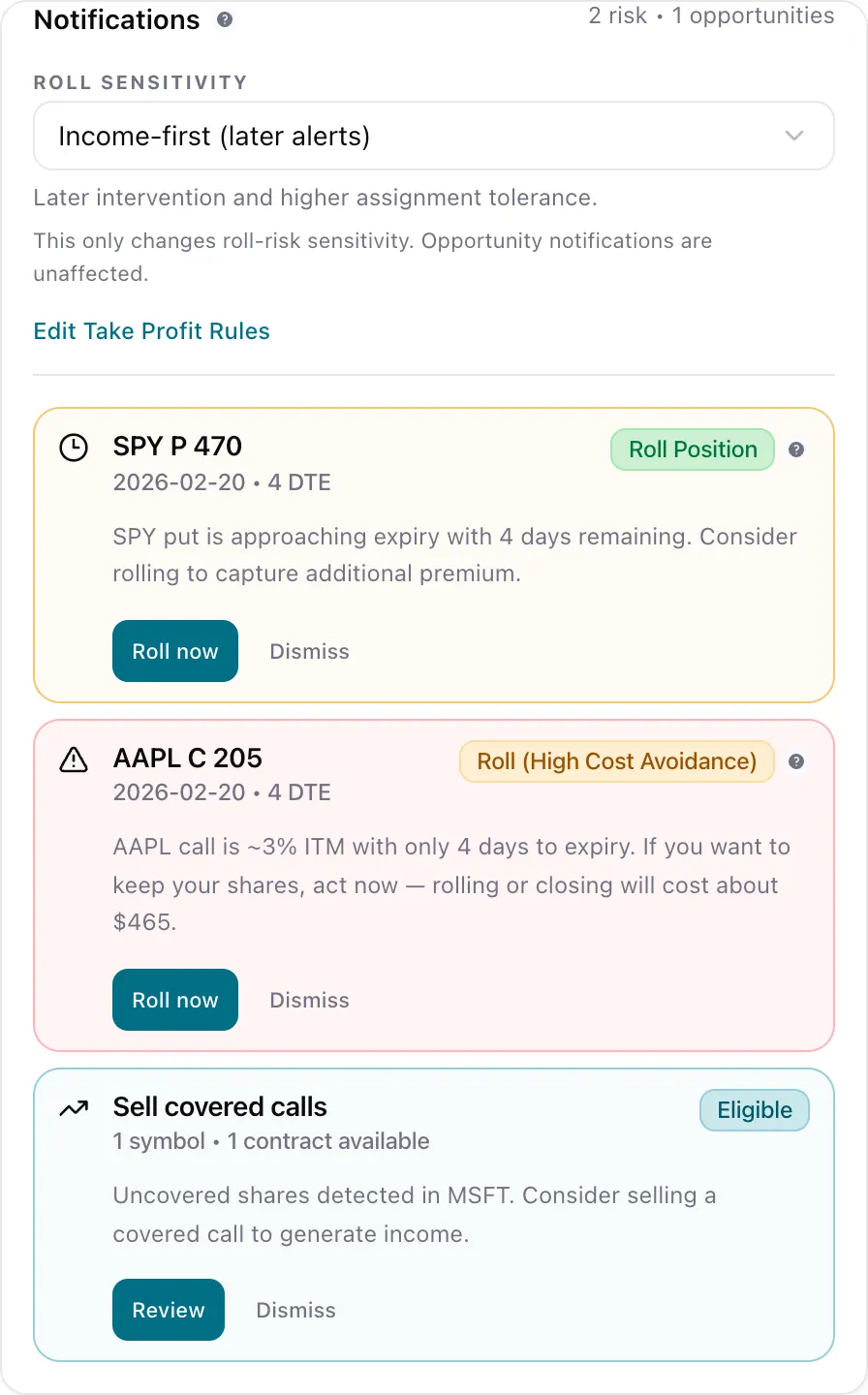 Assignment mechanics showing decision pathways
View detailed position tracking →
Your Three Options at Assignment
Option 1: Take Assignment (Recommended) You buy 100 shares at your strike price. The cash you reserved is used to purchase the stock. You now have a core position at your target price.
Next moves:
- Hold the shares for appreciation
- Sell covered calls against them (the wheel strategy)
- Collect dividends if applicable
- Sell more puts when the stock bounces to lower your cost basis further
This is often the best outcome—you got paid premium to buy a stock you wanted at your target price.
Option 2: Close the Put Early Before expiration, buy back the put at a loss (if ITM) to avoid assignment. You might lose $100-400 of your premium, but you keep your cash available and avoid owning the stock.
When this makes sense:
- You no longer want to own the stock at that price
- A better opportunity has emerged
- The position size would exceed your risk tolerance if assigned
Option 3: Roll the Put Buy to close your current put and simultaneously sell a new put at a later expiration or lower strike. This extends your position and typically collects additional premium.
Rolling scenarios:
- Roll out: Same strike, later expiration (collect more time premium)
- Roll down: Lower strike, same or later expiration (reduce assignment risk, collect less premium)
- Roll out and down: Lower strike, later expiration (balanced adjustment)
Master rolling techniques: Our rolling tested puts guide covers exact scenarios and decision frameworks.
My Recommendation: Plan to Take Assignments
If you're comfortable selling a put at a strike price, you should be comfortable owning the stock at that price. Assignments are features, not bugs. They're the mechanism by which you acquire quality stocks at discounts.
The traders who struggle with CSPs are those who chase premium on stocks they don't actually want to own. When assignment comes, they're stuck with garbage. Don't be that trader.
When Are Seasonal Premiums Richest for Put Selling?
Different times of year offer different premium environments. Understanding these patterns helps you size positions appropriately.
High Premium Periods (Favorable for CSP Sellers)
Earnings seasons (January, April, July, October)
- IV spikes before earnings
- Premiums 30-100% higher than normal
- Strategy: Sell 2-3 weeks before earnings, close before the event, or sell post-earnings when IV remains elevated
January effect (late December through January)
- Tax-loss harvesting creates volatility
- Small caps especially affected
- Strategy: Target quality small caps beaten down for tax reasons
Market corrections/sell-offs (unpredictable timing)
- Fear spikes IV dramatically
- Quality companies offer fat premiums
- Strategy: Aggressively sell puts on blue chips you'd love to own cheaper
Low Premium Periods (Challenging for CSP Sellers)
Quiet summer (June-August)
- Trading volume drops, IV compresses
- Premiums 20-40% below average
- Strategy: Shift to shorter DTE (weekly) or reduce position sizes
Year-end rally (November-December)
- Holiday effect and window dressing reduce volatility
- Strategy: Focus on 14-21 DTE instead of monthly, or sit in cash and wait
Using IV Percentile for Timing
Don't look at absolute IV—look at IV percentile (where current IV ranks against the past year):
| IV Percentile | Environment | CSP Strategy |
|---|---|---|
| >70th | Elevated | Aggressive selling; favor 30-45 DTE for maximum premium capture |
| 50-70th | Normal | Standard approach; any DTE works |
| 30-50th | Low | Reduce position sizes; favor weekly or skip |
<30th | Very Low | Avoid new positions; wait for volatility |
What Risk Management Guardrails Protect Your Cash-Secured Put Account?
Here's what separates consistent income generators from blowups:
1. The Conviction Rule
Never sell a put strike below a price you'd genuinely buy the stock at. This is non-negotiable. If you wouldn't place a buy limit order at that price, don't sell the put.
2. The Probability Cap
Limit assignment probability to 30% or below for most trades. This means most puts expire worthless (premium income), but you're psychologically prepared for the occasional assignment. Use the tables above to calibrate.
3. The Portfolio Stress Test
Size positions to survive a 20% market drop. If you sell a put on a $100 stock at a $95 strike, make sure your portfolio could handle that position dropping to $80 (further ITM) without ruining your year. One position should be no more than 5% of portfolio value.
4. Track Your Actual Results
Keep a trading journal. Over 20+ trades, compare:
- Your theoretical assignment probability vs. actual assignment rate
- Premium collected vs. max risk
- Win rate by DTE and strike distance
If you're getting assigned way more often than expected, your strikes are too aggressive (not OTM enough). If you're getting assigned way less often, your premium might not be compensating you for the risk you're taking.
5. Maintain a Cash Reserve
If you have $100,000 deployed in CSPs, keep $10,000-$20,000 in cash. This provides:
- Dry powder for rolling challenged positions
- Ability to take advantage of market crashes
- Psychological comfort to avoid panic decisions
Your DTE Decision Matrix: Which Strategy Fits You?
Use this table to decide which approach matches your situation:
| Your Situation | Best DTE Strategy | Key Considerations |
|---|---|---|
Small account (<$15K), need frequent income | Weekly (0-7 DTE) | More trades, smaller positions, requires active management |
| Small account, limited time | Monthly (14-21 DTE) | Fewer decisions, still manageable position sizes |
| Moderate account ($25-75K), want balance | Monthly (21-30 DTE) | The Goldilocks zone for most traders |
Large account (>$75K), patient | Deep dive (30-60 DTE) | Larger dollar returns, requires capital discipline |
| Market just sold off 10%+ | Any DTE, but favor longer | Premiums are fat; capture maximum IV |
VIX <15, quiet market | Weekly or wait | Premiums are thin; grind or sit out |
| High conviction on a stock | 30-45 DTE | Wider margin, willing to own long-term |
| Nervous about assignment | 7-14 DTE | Lower assignment probability, faster turnover |
What Is Your Action Plan for Getting Started with CSPs This Week?
Target Income Calculator
Work backwards: set your income goal and find the required capital
Follow these steps to implement your first CSP strategy:
Step 1: Audit Your Capital
How much can you comfortably allocate to puts? Remember the 20-25% rule per position. If you have $20,000, your max position size is $4,000-$5,000 (stock price of $40-$50 per share).
Step 2: Choose Your DTE Strategy
- Just starting out? Begin with monthly (21-30 DTE) on one position
- Small account, active trader? Try weekly (3-7 DTE)
- Large account, patient? Experiment with 45-60 DTE when IV is elevated
Step 3: Screen for Candidates
List 3-5 stocks you'd be happy to own at a 3-5% discount. Use these filters:
- Stock price fits your account size
- Daily volume >1M shares
- You understand the business and would hold for 2+ years
Step 4: Paper Trade First
Place 3-5 paper trades using your chosen DTE strategy. Track:
- Premium collected
- Assignment probability at entry
- Actual outcome (expiration, assignment, or early close)
- Your emotional response to position swings
Step 5: Execute Your First Live Trade
When ready, start small. One contract. Track it obsessively. Learn how your broker handles expiration, assignment, and buying power.
Step 6: Build Your Tracking System
Create a spreadsheet to log:
- Entry date, stock, strike, DTE, premium collected
- Assignment probability at entry
- Exit outcome and date
- Actual ROI
This data becomes invaluable for optimizing your approach.
Why Is DTE Your Primary Lever for Cash-Secured Put Success?
Cash-secured puts are one of the most predictable income tools available to retail traders. But predictability only comes from respecting the mechanics: the days until expiration fundamentally shapes your risk, reward, and time commitment.
Short DTE (0-7 days)? Small premiums, low assignment risk, high trading frequency. Best for active traders and small accounts grinding out weekly income.
Medium DTE (21-30 days)? Balanced premium, moderate assignment risk, manageable time commitment. The sweet spot for most retail traders building consistent income.
Long DTE (30-60 days)? Fat premiums, higher assignment risk, extended capital tie-up. Suitable for patient traders with larger accounts, especially when IV is elevated.
Pick the cycle that fits your capital, temperament, and goals. Then execute with discipline: only sell strikes you'd genuinely buy, respect your assignment probability limits, size positions appropriately, and let the math work over time.
Your cash doesn't have to sit idle earning 4%. Get it working for you. The market will reward your patience and preparation.
Use our CSP screener to find stocks matching your DTE and premium targets right now—open Strategy Analyzer.
Once you've been selling puts consistently for a month, move beyond "how much did I collect?" to tracking annualized ROI and capital efficiency. The Options Premium Tracking guide covers the full tracking system: tier-by-tier aggregation, premium-per-day metrics, and how to benchmark your strategies against each other. When multiple CSPs (and covered calls) run as a system, step up to options portfolio management so strategy allocation, sector concentration, and assignment rates stay under control.
What Are the Next Steps to Expand Your Options Income Strategy?
Once you've mastered the cash-secured put cycle, consider these progressions:
Managing Tested Positions: Know when to roll vs close with our when to roll a tested put decision framework—covering credit available, delta drift, and DTE thresholds.
Covered Call Follow-Up: After assignment, maximize your shares with a covered call follow-up strategy to generate income while holding stock.
The Complete Income System: Learn the wheel strategy—a comprehensive approach that combines CSPs with covered calls for continuous premium generation on the same capital.
Deeper Understanding: Master how options decay and behave with our options Greeks guide, covering theta, delta, gamma, and vega with practical examples for income traders.
Platform-Specific Help: Executing your first trade? Follow our Interactive Brokers walkthrough for selling CSPs with screenshots and exact button clicks.
Comparing Strategies: Not sure if CSPs are right for you? Compare cash-secured puts vs. covered calls to understand which fits your market outlook and capital situation.
Frequently Asked Questions
What DTE is best for cash-secured puts?
The optimal DTE depends on your goals. 7-day puts offer the highest annualized premium but require active management. 30-day puts balance theta decay and flexibility. 60-day puts suit set-and-forget traders willing to accept lower annualized returns for less monitoring.
What is a safe assignment rate to target?
Most experienced CSP sellers target a 10–20% assignment rate. Higher means you're selling too close to the money; lower means you're leaving premium on the table. Track your rate over 3–6 months and adjust strike selection accordingly.
How much cash should I reserve per put?
Reserve the full strike price × 100 shares. For a $50 strike, hold $5,000 in cash or equivalent. Some brokers allow margin for 'cash-secured' puts, but holding full cash eliminates forced liquidation risk.
What happens if I get assigned on a cash-secured put?
Assignment means you buy 100 shares at the strike price. Your cash is exchanged for stock. The premium you collected reduces your cost basis. Most traders then sell covered calls against the shares — continuing the wheel strategy.
Ready to run your first DTE-optimized CSP? Screen live opportunities in the Strategy Analyzer.
Once you know which DTE cycle fits your goals, the next move is applying it to real candidates and comparing whether the premium, assignment risk, and capital lock-up are actually worth it.
Related Articles
Core Income Strategies:
- Best Stocks for Selling Cash-Secured Puts in 2026 - 2026 market-specific stock selection with sector positioning
- How to Sell Put Options: Step-by-Step Execution Guide - Platform-agnostic walkthrough for your first trade
- Cash-Secured Puts vs Covered Calls: Income & Risk Comparison - Choose the right strategy for your situation
- How to Sell Cash-Secured Puts: Interactive Brokers Walkthrough - Platform-specific execution guide
- Rolling Tested Puts: When and How to Manage Challenged CSP Positions - Advanced management techniques
- Rolling Cash-Secured Puts: When and How to Adjust - Extend positions and boost returns
The Wheel Strategy:
- The Wheel Strategy: Complete DTE-Optimized Guide - Combine CSPs with covered calls for continuous income
- Best Stocks for the Wheel Strategy: 2025 Screening Guide - Screening criteria for wheel candidates
Options Greeks & Timing:
- Options Greeks Cheat Sheet: DTE-Specific Reference Guide - Quick reference for Greeks at different expirations
- Implied Volatility & Days to Expiry: Timing Your Options Entries - Optimize entry timing with IV analysis
Capital & Risk:
- Options Buying Power Requirements: Strategy-by-Strategy Capital Guide - Understand broker calculations
- Put Credit Spreads: Defined Risk Alternative - Cap your maximum loss when volatility spikes
- Covered Call Tax Rules: Everything You Need to Know - Tax implications when assigned and selling covered calls
- Options Expiration Calendar 2026–2027: Every Monthly Opex Date
Disclaimer: The examples and guidelines in this article are for educational purposes only. Options trading involves significant risk of loss. Always do your own research, understand the risks, and consider your risk tolerance before trading. Past performance does not guarantee future results.
Last updated: September 24, 2026 by Florian Strauf
Frequently Asked Questions
Written by Florian Strauf
Continue Your Journey
Covered Call Analyzer
Find the best covered call opportunities.
Cash-Secured Put Calculator
Calculate put selling returns.
Demo Portfolio
Explore a sample portfolio with positions and strategy insights — no login required.
Wheel Strategy Calculator
Plan your wheel trades.
Free scanner account
Scan free — then add the full workflow
- Live broker sync (33+ supported brokers; daily auto-refresh for IBKR Flex)
- Portfolio Scanner for comprehensive recommendations
- Strategy backtesting for covered calls and puts
- Full wheel backtesting with buy‑and‑hold comparison